The US 100% Pharma Tariff: What It Means for Nifty Pharma
On Oct 1, 2025, the United States plans to impose a 100% tariff on imports of branded or patented pharmaceutical products, with exemptions for companies that have already broken ground on new US manufacturing.
MK
Dr. Murali KalyanaramanGlobal CFO · 30+ years in corporate finance · Chartered Accountant (ICAI) · 7 min read
Signal panelThe research, before the reading · 7 min full note
01
On Oct 1, 2025, the United States plans to impose a 100% tariff on imports of branded or patented pharmaceutical products, with exemptions for companies that have already broken ground on new US manufacturing.
02
We evaluated each NIFTY Pharma constituent on four dimensions: (1) US revenue exposure (qualitative), (2) US manufacturing presence, (3) branded/specialty exposure in the US, and
03
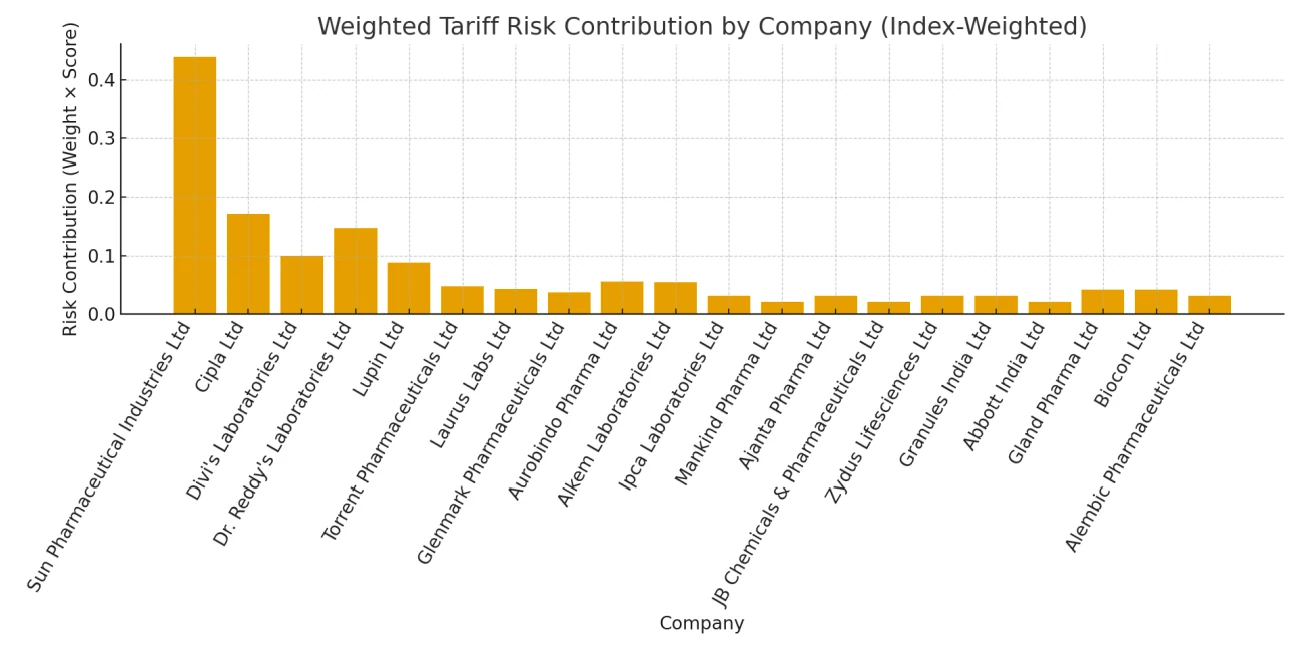
Weighted Index Risk (WIR): 1.49 on a 1–5 scale.
04
Index weights: NIFTY Pharma factsheet as of Aug 29, 2025 (top 10); residual 10 names apportioned equally across remaining weight.
Topic: US 100% Tariff on Branded/Patented Pharmaceutical Imports — Implications for NIFTY Pharma
On Oct 1, 2025, the United States plans to impose a 100% tariff on imports of branded or patented pharmaceutical products, with exemptions for companies that have already broken ground on new US manufacturing. Generics are not targeted. For NIFTY Pharma (India), direct tariff risk is concentrated in specialty/branded products sold into the US and in firms without flexible US manufacturing options. API-focused firms face minimal direct risk; indirect effects (sourcing, partner behavior) remain watch items.
We evaluated each NIFTY Pharma constituent on four dimensions: (1) US revenue exposure (qualitative), (2) US manufacturing presence, (3) branded/specialty exposure in the US, and
role in the value chain (API vs FDF). We assign a Tariff Risk Score (1=Low, 3=Medium, 5=High) tailored to the announced policy. Index weights use the official NSE factsheet top-10 as of Aug 29, 2025; the remaining 10 names share the residual weight equally. Weighted Index Risk (WIR) is the sum over (weight × score) / 100, computed on 2025-09-26.
Weighted Index Risk (WIR): 1.49 on a 1–5 scale. Risk is skewed toward US-heavy generic players with some specialty brands (e.g., Sun) and toward companies without deep US manufacturing buffers (if any). API-centric players like Divi’s score lowest.
Company
Inde x Weig ht %
US Expos ure
US Exposure Notes
US Manufacturing
US Branded/Speci alty
Tari ff Ris k (1– 5)
Sun Pharmaceut ical Industries Ltd
21.99
High
Americas/US a major market; specialty brands like Ilumya/Cequ a sold in US
Yes — Ohm Laboratories, New Brunswick/Cra nbury, NJ
High (specialty brands incl. Ilumya, Cequa)
2.0
Cipla Ltd
11.43
Mediu
FY25 North
Yes — InvaGen
Low-Medium
1.5
m
America revenue about $0.93bn; meaningful but diversified
Pharmaceutical s sites in NY/MA
(largely generics; respiratory devices)
Divi's Laboratorie s Ltd
9.96
Low
Primarily API exporter; limited finished-drug imports into US
No — Global API plants in India; not US FDF
N/A (APIs)
1.0
Dr. Reddy's Laboratorie s Ltd
9.81
High
US is a key market; multiple US manufacturin g sites
Yes — Shreveport, LA; Bristol, TN; Middleburgh, NY
Low (generics/OTC dominant)
1.5
Lupin Ltd
5.86
High
North America ~38% of revenue; sizeable US generic portfolio
Yes — Somerset, New Jersey manufacturing site
Low (largely generics)
1.5
Torrent Pharmaceut icals Ltd
4.76
Low
US ~10% of revenue; India-heavy mix; some USFDA- approved sites
US generics meaningful; no known US FDF manufacturin g
No — India- based sites; sizeable US ANDA portfolio
Low (generics)
1.5
Chart: Index-Weighted Risk Contribution
Assumptions & Watch Items
Policy scope targets branded/patented drugs; generics generally excluded. If biosimilars are deemed 'branded', exposure for Biocon and others would rise.
Exemption hinges on 'building' new US manufacturing, not merely existing facilities. Firms announcing new US builds could materially reduce exposure.
Indirect effects: channel partners may prefer US-made SKUs; working capital and pricing could be affected by re-labelling and supply re-configuration.
Data Notes
Index weights: NIFTY Pharma factsheet as of Aug 29, 2025 (top 10); residual 10 names apportioned equally across remaining weight. Qualitative exposure and manufacturing presence compiled from public disclosures and company sites as of report date.
Non‑Obvious Insights & Edge‑Case Scenarios:
HTS vs. 'Branded/Patented' - Legal mechanics
Tariffs are administered at the Harmonized Tariff Schedule (HTS) line level, while 'branded/patented' is not a customs classification. For operationalization, agencies must map the policy to HS 30xx lines and then define a rule that ties branded/patented status to NDA/BLA (Orange/Purple Book) at entry. Expect initial ambiguity, self‑certification, and audits. Tactical read: enforcement may be uneven early on, presenting a timing window for re‑routing and documentation design.
FDA CMC clocks constrain relocation speed
Even if a firm moves finishing/packaging to the US, most changes trigger manufacturing supplements. Prior‑Approval Supplements (PAS) can have 4–6 month goal dates (and 8–10 months if inspections are required). Plan for dual‑sourcing, bridging inventory, and staggered filings to avoid supply cliffs.
'Construction started' exemption — M&A shortcut
If the exemption hinges on a project with 'construction started', acquiring a target with an already‑in‑progress US site (or restarting a paused build) could qualify sooner than greenfield. Expect competitive bidding for half‑built facilities and quick bolt‑ons (brownfield) rather than pure greenfield.
API‑in, US finish — a tariff‑efficient architecture
Because the tariff targets finished branded imports, one practical workaround is to import APIs/intermediates and perform US fill‑finish/release via CMOs. This shifts value‑add stateside while preserving India’s API lead. Downside: sterile capacity is tight; QA/tech‑transfer bottlenecks are real.
PBM/formulary knock‑ons
If landed costs spike for branded imports, PBMs have incentive to push harder on step‑edits and substitution. This can raise generic penetration, benefiting Indian Gx—provided there is capacity and FDA compliance headroom.
Shortage carve‑outs are plausible
In the event of a medically necessary shortage, US agencies can grant targeted relief. Firms maintaining transparent shortage dashboards and proactive FDA communication may secure exemptions faster.
Biosimilars gray zone
Biosimilars are licensed under BLAs and often marketed with brand names but typically lack active patent shields. If the rule keys off 'patented', biosimilars could be spared; if it keys off 'branded', exposure rises. Maintain two playbooks pending legal text.
Customs + FDA convergence risk (July rule change)
Recent revocation of low‑value shipment exemptions means more FDA scrutiny of all inbound lots. Expect longer clearance times and tighter document hygiene at ports; factor that into cycle stock.
Puerto Rico renaissance?
Puerto Rico retains deep pharma infrastructure and incentives. Expect renewed interest for quick US‑soil manufacturing, especially for oral solids and some sterile lines with refurbishment potential.
India opportunity — upstream wins even if US finish localizes
Even with US finishing, API and key intermediate demand can grow. API leaders (e.g., Divi’s, Laurus) can win on upstream volumes and higher value CDMO/HPAPI work while innovators localize the last mile in the US.
Disclosures and notes
Disclaimer
This report is for informational purposes only and does not constitute investment advice. While efforts have been made to ensure accuracy, no warranty is expressed or implied. Investors should perform their own due diligence and consider consulting a qualified advisor.
This research is for information and education only and is not investment advice. Figures may be provisional. Oorjita.AI and its authors may hold positions in securities mentioned. Please consult a SEBI-registered investment adviser before making investment decisions. Published Friday, 26 September 2025, 2:44 PM IST.