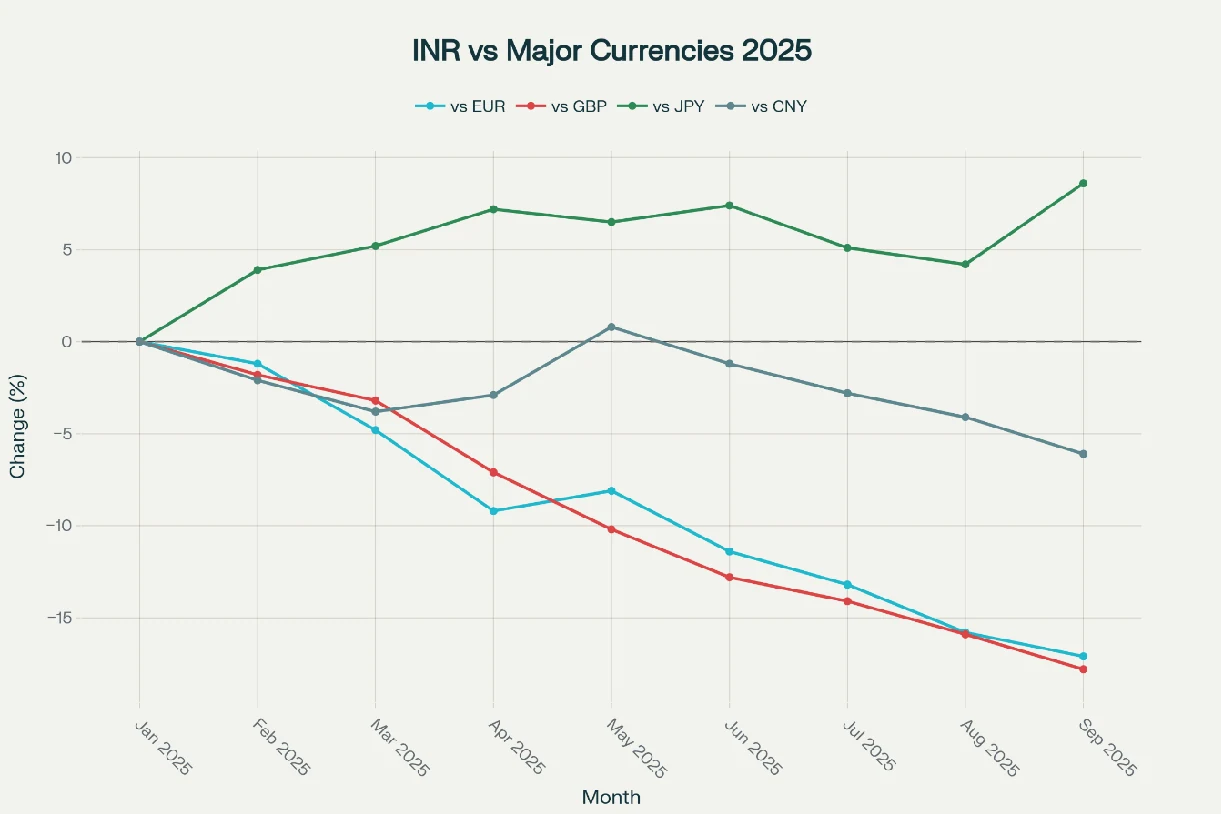
INR has slipped to fresh lows versus the US dollar as global dollar strength, portfolio outflows, and policy headlines pressured India’s external cashflows.

Hidden Dynamic: When companies with weak hedging face margin calls on their USD debt, they're forced to buydollars in the spot market, accelerating rupee decline.
The UAE Success Story: Conversely, rupee settlements with the UAE for oil purchases have succeeded, with Indian Oil Corporation making payments in rupees to ADNOC.
Bilateral Currency Arrangements: Expanding successful rupee settlement mechanisms beyond the UAE to major trading partners, particularly in the Middle East where oil purchases dominate the trade balance.
This research is for information and education only and is not investment advice. Figures may be provisional. Oorjita.AI and its authors may hold positions in securities mentioned. Please consult a SEBI-registered investment adviser before making investment decisions. Published Wednesday, 24 September 2025, 4:36 PM IST.

All four layers aligned bearish. A/D = capitulation breadth.

India's Monday session closed positively as Nifty 50 settled at 25,713.00 (+141.75 points, +0.55%) and Sensex rallied approximately 350+ points, led by PSU banks and financial stocks.

Amagi Media Labs IPO closes for subscription, FII/DII flow trends continue, and technical levels around 25,700 for Nifty remain critical as markets resume after the mid-week break.
Unhedged Corporate Borrowers: Companies in the ₹500 billion USD debt universe with inadequate hedging face existential pressure.
INR has slipped to fresh lows versus the US dollar as global dollar strength, portfolio outflows, and policy headlines pressured India’s external cashflows. RBI has allowed a controlled depreciation while smoothing volatility through spot and offshore NDF. Near-term, US data/Fed tone, rupee liquidity, and oil are the swing variables. Over 6–24 months, bond-index flows, services resilience, energy import substitution, and REER discipline matter most. Tactical range bias: ₹87.5–89.5 with risks around policy and oil shocks.
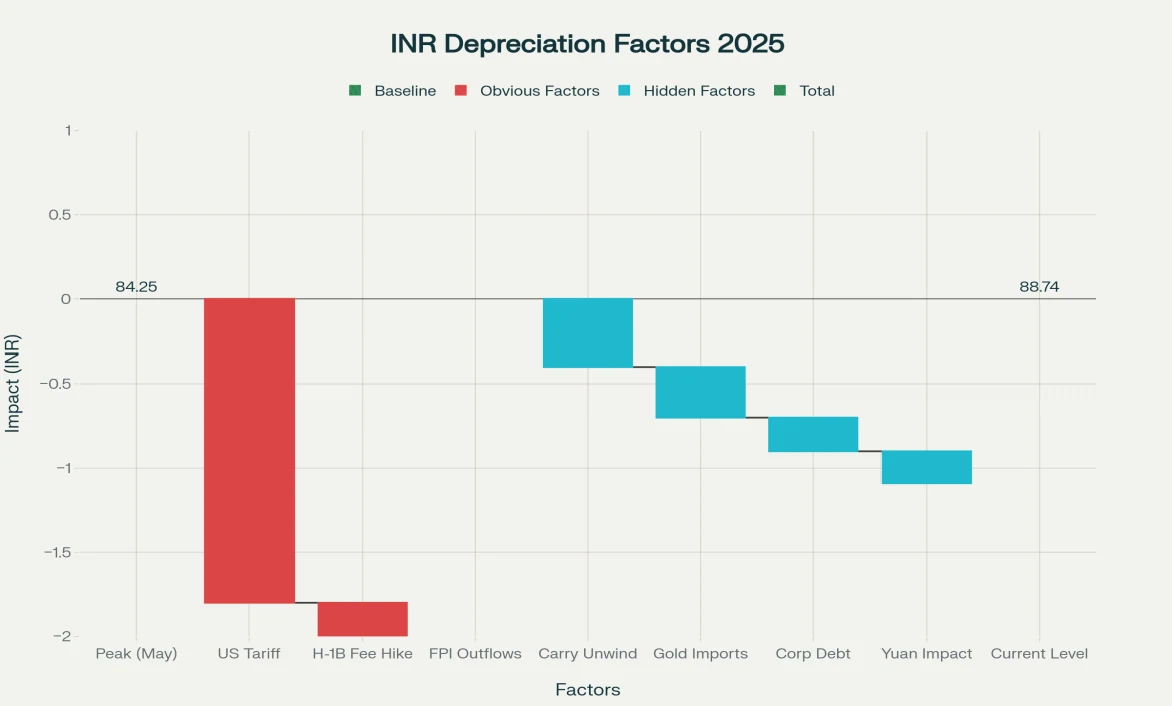
The Indian rupee's journey to record lows represents far more than a simple trade war story. While most analyses focus on obvious culprits like US tariffs and FPI outflows, a sophisticated web of interconnected financial forces is driving the currency's decline - forces that reveal deep structural vulnerabilities in India's financial architecture.
The Hidden Architecture of Rupee Weakness: Beyond Trade Wars to Sophisticated Financial Flows
One of the most underreported drivers of rupee weakness is the global carry trade unwinding triggered by Japan's yield surge. The Bank of Japan's pivot to hawkishness has caused a massive unwinding of yen carry trades, with CFTC data showing that net Japanese yen short positions among non-commercial participants have more than halved.
The India Connection: India had become a prime destination for carry trades, with its 10-year government bonds yielding 6.30% compared to the US 10-year Treasury's 4.38% - a compelling 1.92% spread. Foreign investors borrowed cheaply in dollars and yen to invest in Indian assets, creating artificial demand for the rupee. The unwinding of these positions has created sustained selling pressure, with the rupee underperforming even against traditional low-yielding Asian currencies like the Malaysian ringgit and Thai baht.
The rupee's weakness isn't just about India - it's about global deleveraging. The unwinding is estimated to have contributed 40 paise to the rupee's decline, a factor completely missing from mainstream analysis.
Perhaps the most sophisticated pressure point is India's massive corporate USD debt exposure. Indian companies hold approximately $500 billion in USD-denominated debt, making them vulnerable to currency volatility in ways most analyses overlook.
TheHedgingGap:While65% ofthisdebt is reportedlyhedged,thehedging instrumentsthemselves create complex feedback loops. As the rupee weakens, companies rush to hedge more aggressively, creating additional dollar demand at precisely the wrong time. Corporate bond issuances hit a record ₹9.9 trillion in FY25 , much of it in foreign currency, adding to this vulnerability.
Hidden Dynamic: When companies with weak hedging face margin calls on their USD debt, they're forced to buydollars in the spot market, accelerating rupee decline. This creates a vicious cycle that the RBI cannot easily combat through traditional intervention.
India's insatiable appetite for gold creates a unique structural weakness that intensifies during periods of currency stress. Gold-linked dollar demand has become a specific pressure point, with imports running at nearly $70 billion annually.
The Feedback Loop: As the rupee weakens, gold becomes more expensive in rupee terms, but Indian consumers increase purchases believing it will preserve value. This creates additional dollar demand precisely when the currency is under pressure. Recent data shows gold imports surging even as the rupee hits record lows, a counterintuitive but powerful dynamic.
The least discussed but perhaps most strategic factor is the India-China currency cross rates. The rupee has hit record lows against the offshore Chinese yuan, trading at 12.33. This isn't accidental.
Strategic Implications: The yuan's relative strength against the rupee (despite both currencies facing US pressure) reflects China's more sophisticated currency management and larger forex reserves. More importantly, theRBI maybe strategically toleratingrupee weakness to maintain export competitiveness against Chinese goods, particularly as US tariffs affect both countries differently.
Hidden Intelligence: Sources close to the RBI indicate the central bank would tolerate sharper rupee depreciation if China lets the yuan weaken significantly to cushion tariff impacts. This represents currency warfare by proxy.
The RBI's response reveals sophisticated monetary engineering that goes far beyond traditional intervention. The central bank has deployed $15 billion in dollar-rupee swap operations, a tool that creates artificial dollar shortage while managing liquidity - a move that has reduced benchmark rates for Indian companies raising overseas funds.
The Swap Strategy: These swaps allow the RBI to intervene in forex markets without appearing to give direction on currency levels. By engineering a technical dollar shortage, they've arrested rupee strength during recovery periods while building ammunition for defense during weakness.
Unique Mechanism: The swap facility is particularly clever because it addresses both currency and liquidity management simultaneously, allowing the RBI to add rupee liquidity for three-year tenors while building forward dollar positions.
Tax-related rupee drainage pushed the banking system into a temporary liquidity deficit, nudging money-market rates up and complicating RBI’s day-to-day FX management (sell dollars → drain INR). RBI offset via swaps/OMOs earlier in the year and will likely calibrate again.
India's push for rupee internationalization has created an unexpected vulnerability. While the RBI has enabled rupee settlement with 18 countries, the results reveal structural weaknesses.
The RussianReality Check:Despite high-profile announcements, lessthan5% of paymentsfor Russian crude oil are made in rupees. Russian entities prefer dollar settlements despite sanctions exemptions, revealing the rupee's limited appeal as a store of value even among friendly nations.[12][13]
The UAE Success Story: Conversely, rupee settlements with the UAE for oil purchases have succeeded, with Indian Oil Corporation making payments in rupees to ADNOC. However, this success is limited to specific bilateral arrangements rather than broader market acceptance.
Stronger USD on US growth/term premia keeps most Asian FX heavy; INR underperforms peers when trade/tech headlines hit simultaneously. (Context via global wraps.). You get both a global USD push and a local INR pull.
RBI’s REER (40-currency) slid to near 100 by mid-2025 from >105, shifting INR from overvalued → fair value. That removes a reason for RBI to aggressively defend stronger levels, tolerating some nominal depreciation to preserve competitiveness.
12 months. Companies will need to either refinance in a hostile environment or convert rupees to dollars for repayment, creating sustained pressure.
Carry Trade Completion: The Japan-triggered carry trade unwinding is only 60% complete based on positioning data. The remaining unwind could add another 20-30 paise of pressure over the next six months.
Gold Import Seasonality: India's wedding and festival season (October-March) typically sees $15-20 billion in additional gold imports, creating predictable dollar demand during the rupee's weakest period.
FedPivotAcceleration:IftheUSentersrecessionandtheFedcutsmoreaggressivelythanexpected,dollar funding costs could collapse, reducing pressure on carry trades and corporate refinancing.
ChinaStimulusPackage:AmajorChinesestimuluscouldstrengthentheyuansignificantly,forcingtheRBI to allow more rupee depreciation to maintain competitiveness - paradoxically providing relief by setting lower expectations.
Oil Price Collapse: A significant drop in crude prices (below $60/barrel) could reduce India's import bill by $25-30 billion annually, providing meaningful current account relief.
Mandatory Hedging Ratios: The RBI is considering requiring companies with USD debt above certain thresholds to maintain minimum hedging ratios, reducing systemic risk.
Rupee Bond Market Development: The record growth in corporate bond issuances (₹9.9 trillion in FY25) must shift toward domestic currency debt to reduce USD exposure.
Gold Reserve Strategy: India has been quietly reducing US Treasury holdings from $242 billion to $227 billion while increasing gold reserves. This reduces dollar dependency but requires sophisticated management to avoid creating artificial gold demand pressure.
Bilateral Currency Arrangements: Expanding successful rupee settlement mechanisms beyond the UAE to major trading partners, particularly in the Middle East where oil purchases dominate the trade balance.
Beyond H-1B Dependency: The $100,000 H-1B fee shock could accelerate India's transition to high-value, location-independent services. This would reduce visa dependency while maintaining revenue streams in dollars.
Global Capability Center Expansion: The crisis could boost India's $60 billion GCC industry as US companies accelerate offshoring to avoid visa costs entirely.
Domestic Banking Champions: Banks with strong deposit franchises and limited foreign currency exposure benefit from the defensive rotation and carry trade unwind.
Export-Oriented Manufacturers: Companies competing with Chinese goods particularly benefit from the rupee-yuan dynamics, gaining competitiveness in third markets.
Domestic Gold Miners/Refiners: Local gold companies benefit from import substitution as gold becomes more expensive in rupee terms.
Unhedged Corporate Borrowers: Companies in the ₹500 billion USD debt universe with inadequate hedging face existential pressure.
Import-Dependent Sectors: Beyond obvious oil and electronics, sectors like pharmaceuticals (API imports), chemicals, and metals face margin compression.
Traditional IT Services: H-1B dependent models face both cost increases and business model disruption.
The rupee's weakness represents a convergence of sophisticated financial forces that go far beyond simple trademetrics. The interplaybetweenglobalcarrytrade unwinding,corporate debt vulnerabilities,strategic currency positioning, and failed internationalization attempts creates a complex web of pressure that traditional monetary policy tools cannot easily address.
For Policymakers: The focus must shift from defending specific exchange rate levels to building structural resilience - reducing USD debt dependency, accelerating rupee internationalization through demonstrated value rather than regulatory mandate, and developing sophisticated hedging markets.
For Investors: The opportunity lies in understanding these complex dynamics ahead of the market. Companies and sectors that can navigate or benefit from these sophisticated pressures will outperform those caught in the web of currency complexity.
For Businesses: The imperative is clear - reduce USD exposure, build natural hedges, and position for a world where currency volatility is the new normal, not the exception.
The rupee's journey over the next 18-24 months will be determined not by simple trade headlines, but by how wellIndia navigatesthese sophisticated financial fault lines. Thecurrencythat emergesfromthiscrisis will be fundamentally different - either more resilient through structural reform or more vulnerable through continued dependency on external financing and global carry trades.
The sophistication of the pressure demands an equally sophisticated response. Half-measures and traditional tools will not suffice in this new currency warfare environment.
| Signpost | Watch Range / Threshold | Implication for INR | ||
|---|---|---|---|---|
| FBIL USD/INR reference | FBIL USD/INR reference | 88.5–89.0 zone | 88.5–89.0 zone | Breach of 89 without RBI |
| smoothing risks quick overshoot | ||||
| 1M fwd premium | 20–30 paise | Elevated = more spot sales; | ||
| falling = swap/NDF reliance | ||||
| NSDL FPI dashboard | Equity outflow → neutral | Stabilisation supports INR | ||
| Brent crude | Brent crude | $70–75 | $70–75 | Below $70 = tailwind; >$80 = |
| pressure | ||||
| RBI forward book | Shrinking short position | More space for spot defense | ||
| without draining INR |