Advait Energy Transitions: A Green-Hydrogen Pivot, Priced 25–40% Too High
India's power transmission network requires massive expansion to support the target of 500 GW renewable energy capacity by 2030. The government's focus on grid modernization and interstate transmission corridors creates a multi-billion dollar opportunity.
MK
Dr. Murali KalyanaramanGlobal CFO · 30+ years in corporate finance · Chartered Accountant (ICAI) · 91 min read
This research is for information and education only and is not investment advice. Figures may be provisional. Oorjita.AI and its authors may hold positions in securities mentioned. Please consult a SEBI-registered investment adviser before making investment decisions. Published Monday, 16 February 2026, 3:04 PM IST.
Signal panelThe research, before the reading · 91 min full note
01
Advait Energy Transitions Limited: (NSE: ADVAIT, BSE: 543230) is an Ahmedabad-based company operating in power transmission infrastructure and rapidly transitioning into renewable energy solutions, particularly green hydrogen technology.
02
Bear case (30% probability): Delays and scaling back → Electrolyser revenue caps at ₹50-75 Cr, stranded assets
Comprehensive Investment Analysis: Advait Energy Transitions Limited
Complete Report with Validated Data | February 13, 2026
Advait Energy Transitions Limited (NSE: ADVAIT, BSE: 543230) is an Ahmedabad-based company operating in power transmission infrastructure and rapidly transitioning into renewable energy solutions, particularly green hydrogen technology. Founded in 2009 and listed on BSE, the company has executed over 450 projects across 45+ countries and reported consolidated revenue of ₹486.33 crore in 9M FY26, up 138% YoY. Current Price (Feb 13, 2026):₹1,662Market Capitalization:₹1,899 crore52-Week Performance: Stock up significantly but with high volatility
1Business Overview & Market Potential
Core Business Activities
Advait operates through three primary business verticals:
A. Power Transmission & Substation Solutions (Core Business - ~70% Revenue)
Stringing tools and equipment for transmission lines
ACS (Aluminum Clad Steel) wire manufacturing
OPGW (Optical Ground Wire) operations and fiber networks
Emergency Restoration Systems (ERS)
Live-line installation services (completed over 10,000 km of live-line projects globally)
Turnkey EPC solutions for power utilities
B. Telecommunication Infrastructure (~15% Revenue)
Turnkey telecom tower projects
OPGW/OFS manufacturing through JV with TG China
Fiber optic network deployment
C. Green Energy Transition (Launched 2023 - Rapidly Growing ~15% Revenue)
Alkaline and PEM electrolyser systems (120 MW/year capacity in Kadi, Gujarat, expanding to 200 MW/year)
Fuel cell systems (partnership with TECO 2030 AS from Norway)
Hydrogen refueling stations (HRS)
Battery Energy Storage Systems (BESS)
Solar EPC projects (contributed ₹71.56 lakh in Q3 FY26)
Carbon credit consultancy and sustainability services
Industry & Sub-Sectors
Electrical Equipment & Power Transmission (primary)
Renewable Energy Infrastructure (emerging high-growth segment)
Green Hydrogen Ecosystem (nascent but strategic)
Telecommunication Infrastructure (supporting)
Total Addressable Market (TAM)
Power Transmission Market: India's power transmission network requires massive expansion to support the target of 500 GW renewable energy capacity by 2030. The government's focus on grid modernization and interstate transmission corridors creates a multi-billion dollar opportunity. The Union Budget 2026's focus on energy security and grid strengthening provides strong long-term tailwinds. Green Hydrogen Market: India's National Green Hydrogen Mission targets 5 MMT annual production by 2030. With electrolyser capacity being set up at 120 MW/year (expandable to 200 MW/year), Advait is positioned in a market expected to grow at 50%+ CAGR through 2030. The PLI scheme provides additional support for domestic manufacturing. BESS & Solar EPC: Every renewable tender now includes storage requirements, creating exponential demand for battery storage systems. The BOO (Build-Own-Operate) model provides recurring revenue opportunities.
Estimated TAM:
Power Transmission Infrastructure: $15-20 billion annually in India
Green Hydrogen Equipment: $5-8 billion by 2030 in India
BESS Market: $10-15 billion by 2030 in India
Industry Life Cycle Stage
Power Transmission: Mature but with ongoing modernization (steady 8-12% growth)
Green Hydrogen & BESS: Emerging stage with high growth potential (50%+ CAGR) but execution risks
Overall Assessment: Transitioning from mature to emerging high-growth segments
2Market Positioning
Market Share & Competitive Standing
Advait holds a niche position in specialized segments:
One of few companies globally to complete 10,000+ km of live-line installations
Early mover in domestic electrolyser manufacturing under PLI scheme
Estimated <5% market share in overall power transmission equipment
Stronger positioning in specialized tools and ERS systems (estimated 15-20% market share in niche) Order Book Strength:₹1,048 crore as of Dec 31, 2025 (+132% YoY), providing strong revenue visibility. Power transmission solutions contribute 84% of order book, while new & renewable energy accounts for 16%. Recent Major Win: Secured largest-ever EPC order of ₹216 crore from PGVCL for reconductoring of 11 kV distribution lines.
Moderate brand recognition in B2B power transmission segment
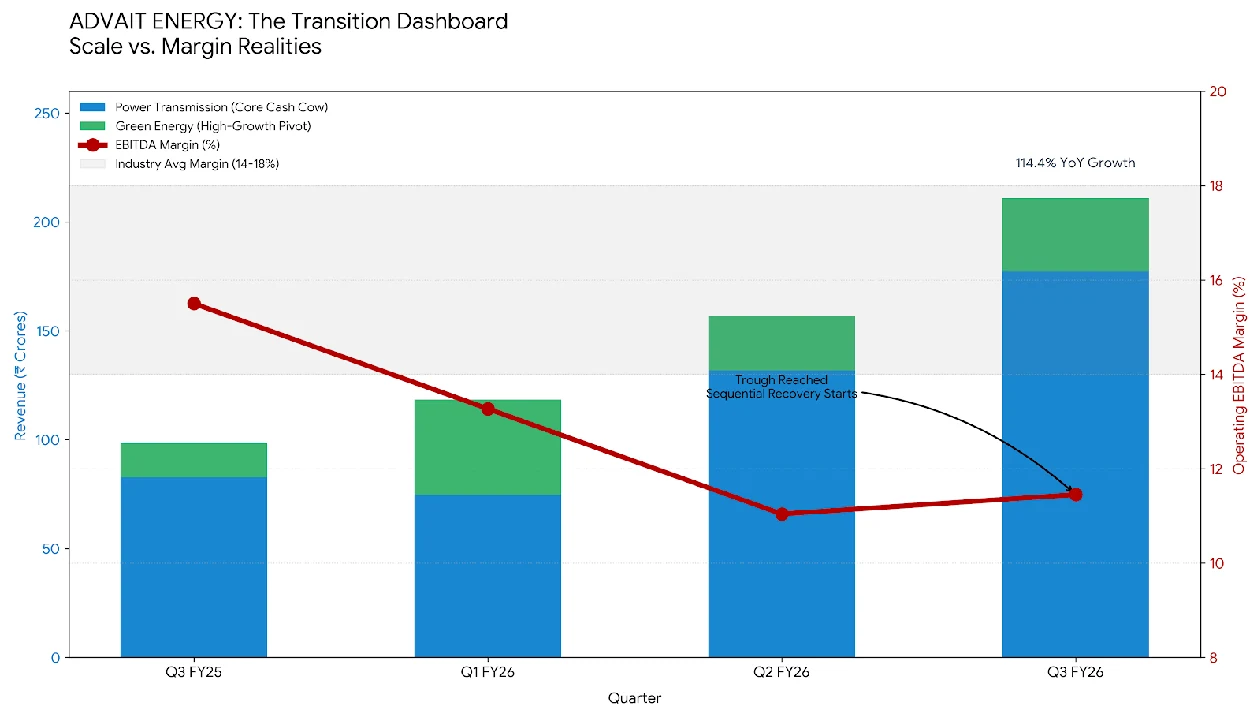
Limited pricing power evidenced by operating margin compression from 15.50% (Q3 FY25) to 11.45% (Q3 FY26) despite 114% revenue growth
However: Sequential margin recovery visible - net margin improved from 6.48% (Q2 FY26) to 8.24% (Q3 FY26), suggesting potential stabilization
Emerging differentiation in green hydrogen equipment manufacturing
3Business Moats
Identified Competitive Advantages
1. Technical Expertise in Live-Line Installations
• Rating: 7/10
Justification: Specialized capability achieved by handful of companies globally; high entry barriers due to safety requirements, extensive training, and international certifications
Durability: High - capability built over 15+ years
Uniqueness: Medium-High - few competitors globally
2. First-Mover Advantage in Domestic Green Hydrogen Manufacturing
• Rating: 6/10
Justification: Among early Indian companies with operational electrolyser facility under PLI scheme; technology partnerships with TECO 2030 (fuel cells) and CENmat (electrolysers) provide technological edge
Durability: Medium - advantage lasts 2-3 years until larger players scale up
Uniqueness: Medium - Reliance and L&T entering but Advait has head start
3. Integrated End-to-End Solution Portfolio
• Rating: 5/10
Justification: Ability to provide complete solutions from transmission tools to OPGW to green hydrogen creates customer stickiness and cross-selling opportunities
Durability: Medium - competitors can replicate through partnerships
Uniqueness: Low-Medium - not deeply differentiated
4. Strategic Technology Partnerships & JVs
• Rating: 6/10
Justification: JV with TG China for OPGW, partnership with TECO 2030 for fuel cells (4.89% stake acquired), and multiple MoUs for electrolyser technology provide access to cutting-edge technology without full R&D investment
Durability: Medium - dependent on partner relationships
Uniqueness: Medium - partnerships themselves are valuable
5. Geographic Execution Capability
• Rating: 5/10
Justification: Presence in 45+ countries demonstrates execution capability and risk management in diverse environments
Durability: Low-Medium - operational capability but not a moat
Uniqueness: Low - many competitors operate internationally
6. Strong Order Book Providing Revenue Visibility
• Rating: 6/10
Justification:₹1,048 crore order book (132% YoY growth) provides 12-15 months of revenue visibility
Durability: Medium - order book needs continuous replenishment
Uniqueness: Medium - reflects strong execution and customer relationships
4Moat Rating & Overall Score
Moat Category
Rating (1-10)
Durability
Uniqueness
Strategic Value
Technical Expertise (Live-Line)
7
High
Medium-High
High
Green Hydrogen First-Mover
6
Medium
Medium
Very High
Integrated Portfolio
5
Medium
Low-Medium
Medium
Strategic Partnerships
6
Medium
Medium
High
Geographic Presence
5
Low-Medium
Low
Medium
Order Book Strength
6
Medium
Medium
High
Overall Competitive Advantage Score: 5.8/10 (Moderate moat with emerging strengths) Assessment: Advait possesses moderate competitive advantages primarily in specialized technical services and early positioning in green hydrogen. The strategic pivot into high-growth segments could strengthen moats if execution succeeds, but current advantages are not deeply entrenched. The concerning margin compression (operating margin from 15.5% to 11.45% YoY) despite strong revenue growth indicates limited pricing power. However, the sequential quarterly improvement (net margin from 6.48% in Q2 to 8.24% in Q3 FY26) suggests potential stabilization. Key Risk: Large players like Reliance and L&T entering green hydrogen with significantly deeper pockets could erode Advait's first-mover advantage within 2-3 years.
Sequential QoQ margin recovery - improvement from 6.48% (Q2) to 8.24% (Q3) net margin suggests potential stabilization
YoY margin compression remains concerning - Operating margin declined 404 bps from 15.50% to 11.45%
Stock rallied 9.33% post-results, closing at ₹1,791.35 on Feb 11, 2026 (corrected to ₹1,745.60 by Feb 13)
Margin Analysis - YoY Compression vs QoQ Recovery:
Metric
Q3 FY25
Q2 FY26
Q3 FY26
YoY Change
Q
oQ Change
Revenue
₹98.4 Cr
₹156.9 Cr
₹211.0 Cr
+114.4%
+
34.5%
Operating Margin
15.50%
~11.04%
11.45%
-404 bps
+41 bps
Net Margin
9.95%
6.48%
8.24%
-171 bps
+
176 bps
Critical Insight: While YoY margin compression is concerning, the strong QoQ recovery (+176 bps in net margin) suggests the worst may be behind. Q4 FY26 results will be critical to confirm if margin stabilization is sustainable.
Q2 FY26 Performance (Jul-Sep 2025)
Revenue:
Consolidated Revenue: ₹156.87 crore (+239% YoY vs ₹46.24 crore in Q2 FY25)
Sequential growth: +32.5% QoQ vs Q1 FY26
Profitability:
Net Profit: ₹10.54 crore (some sources report ₹10.16 crore - minor reporting variation)
Net Profit Margin: 6.48% (compressed from prior quarters)
Operating Margin: 11.04%
Key Points:
Strong revenue momentum continued
Margins at trough levels during scale-up phase
Operating profit grew 26% QoQ to ₹17.32 crore
Q1 FY26 Performance (Apr-Jun 2025)
Revenue:
Consolidated Revenue: ₹118.43 crore (+99% YoY vs ₹59.50 crore in Q1 FY25)
Strong start to fiscal year
Profitability:
Net Profit: ₹9.69 crore (+79% YoY vs ₹5.41 crore)
Net Profit Margin: ~8.18%
Standalone EBITDA Margin: 15.68%
Strategic Highlights:
Power Transmission Solutions: 62.8% of revenue
New & Renewable Energy: 37.2% of revenue
Order book at ₹757 crore (+82% YoY)
Utilized funds from ₹91.16 crore preferential issue for working capital and expansion
9M FY26 Cumulative Performance (Apr-Dec 2025)
Consolidated Results:
Revenue from Operations:₹486.33 crore (+138% YoY vs ₹204.15 crore in 9M FY25)
Total Income:₹493.76 crore
EBITDA:₹64.52 crore (+82% YoY)
Profit After Tax:₹36.50 crore (+90% YoY vs ₹19.23 crore)
EBITDA Margin:13.27% (compressed from 9M FY25 levels)
Standalone Results (9M FY26):
Revenue: ₹293.63 crore (+46.75% YoY vs ₹200.10 crore)
Net Profit:₹32.05 crore (vs ₹21.89 crore in FY24, +46.4% YoY)
EPS:₹29.06 (vs ₹21.45 in FY24, +35.5% YoY)
Net Profit Margin:8.03% (vs 10.48% in FY24) - margin compression evident
Balance Sheet Strength:
Total Assets:₹492.15 crore
Net Worth:₹208.02 crore
Shareholder Equity:₹254 crore
Debt-to-Equity: 0.29x (significantly improved from 0.75x in FY24)
Cash Flow:
Operating Cash Flow: Positive but working capital intensive
Cash & Equivalents:₹140 million (net cash positive company)
FY25 Standalone Results
Revenue:₹295.48 crore (vs ₹207.43 crore in FY24, +42.4% YoY)
PAT:₹31.49 crore (vs ₹21.33 crore in FY24, +47.6% YoY)
Standalone EPS:₹29.57 (vs ₹20.92 in FY24)
Industry Comparison & Audit Note
Audit Opinion: The FY25 consolidated results received a qualified audit opinion due to delayed correction of a material error in a joint venture's financial statements. Management attributed this to internal approval process delays within the JV partner. This is a governance red flag that investors should monitor.
Industry Comparison:
While absolute growth rates are impressive, Advait's margin profile lags behind established players:
Industry average EBITDA margin: 14-18%
Advait's EBITDA margin (9M FY26): 13.27%
Gap indicates either aggressive pricing for market share or cost structure challenges
Historical Performance Trajectory
Metric
FY22
FY23
FY24
FY25
9M FY26
Revenue (₹ Cr)
78.5
115.3
208.8
399.1
486.3*
PAT (₹ Cr)
6.5
9.8
21.9
32.1
36.5*
PAT Margin (%)
8.3%
8.5%
10.5%
8.0%
7.5%*
ROE (%)
14.1%
18.5%
47.3%
42.4%
-
*9M annualized run-rate
Key Trends:
Revenue: Explosive CAGR of ~71% (FY22-FY25)
Margins: Volatile and compressing in recent quarters
ROE: Exceptional at 42%+ indicating high capital efficiency
Consistency: Seven consecutive quarters of growth
7Strategic Investments & Execution
Major Strategic Initiatives
1. Green Hydrogen Manufacturing Capacity Expansion
Phase 2 (In Progress): Expansion to 200 MW/year under SECI-PLI program - ON TRACK
Investment: Significant capex allocated from preferential issue proceeds Say-to-Do Status: Executing as Promised - facility operational and ramping production
Advait Energy Holdings AS acquired 4.89% equity stake in TECO 2030 AS (Norway)
MoU signed April 11, 2024 for fuel cell commercialization in India and SRAAC markets
Focus: Marine-grade and stationary fuel cell systems
Strategic Value:
Access to proven PEM fuel cell technology
Import substitution opportunity in fuel cells
Potential for technology transfer and localization Say-to-Do Status: Executing Well - staged investments completed, technology transfer progressing
3. Haryana City Gas MoU (January 2025)
Project Details:
2,000 MTPA green hydrogen production facility
Includes 15 MW electrolyser with EPC, Balance of Plant (BoP), O&M and advisory services
Location: Haryana Say-to-Do Status: Early Stage - non-binding MoU; awaiting definitive commercial agreements and project FID
4. India Energy Week 2026 MoUs (January 27-30, 2026)
Through subsidiary Advait Greenergy Private Limited, signed multiple strategic MoUs:
Partner
Technology/Focus
Strategic Rationale
V J Industries
Hydrogen storage systems
Integration capability for end-to-end H2 solutions
CENmat
PEM & AEM electrolyser technology
Next-generation electrolyser tech with better efficiency
Power to Hydrogen
AEM electrolyser-based projects
Project execution pipeline
Inc
Say-to-Do Status: Non-Binding MoUs - definitive agreements and execution timelines pending. High risk of non-conversion given multiple parallel MoUs.
5. Advaiteco Technologies Launch (Mid-2025)
Structure:
Wholly-owned subsidiary for manufacturing green hydrogen ecosystem components
Manufacturing: Electrolysers, fuel-cell stacks, hydrogen refueling stations, storage units
Strategic goal: Import substitution and Atmanirbhar Bharat alignment Say-to-Do Status: Established and Operational - subsidiary incorporated and manufacturing initiated.
The "David vs. Goliath" Hydrogen Segment Comparison
This table highlights how Advait intends to survive in a market dominated by industrial giants like Reliance and L&T.
Feature
Advait (The David)
Reliance/L&T (The
Strategic Implication
Goliaths)
Manufacturing
200 MW/year (Target
1.5 GW to 5 GW+
1.5 GW to 5 GW+
Advait is 25x smaller than Reliance
Scale
FY27)
in terms of raw capacity.
Target Market
Distributed Hydrogen (10–50 MW systems)
Gigawatt-scale industrial projects
Advait avoids direct head-to-head competition for mega-tenders.
Competitive Edge
Nimbleness & Customization.
Economy of Scale & Deep Pockets
Advait can pivot to niche customer
needs faster than large
bureaucracies.
Technology Strategy
Partnership-based (TECO 2030, CENmat)
Heavy In-house R&D + Acquisitions
Advait is capital-efficient but dependent on partners for IP.
Cost Advantage
PLI benefits (~15-20% cost edge)
Integrated value chain (production to distribution)
Advait wins on initial price;
Goliaths win on long-term lifecycle
costs.
6. Carbon Credit Business Development
Targets:
Current Holdings: 4+ million carbon credits
Target by 2027: 80 million+ carbon credits (20x growth in 1.5 years)
Business Model: Carbon credit aggregation, consultancy, and trading Say-to-Do Status: HIGHLY AGGRESSIVE TARGET - 20x growth in 18 months appears unrealistic without major M&A or partnerships. High probability of missing target.
7. Major Order Wins (Recent)
₹216 Crore EPC Order (Q3 FY26):
Customer: Paschim Gujarat Vij Company Limited (PGVCL)
Scope: Reconductoring of 11 kV distribution lines
Largest single order in company history
Execution timeline: 18-24 months
Execution Assessment - Say-to-Do Ratio
Initiative
Committed
Delivered
Status
Score
Electrolyser Manufacturing (120
Operational
Operational
10/10
10/10
MW)
TECO 2030 Partnership
Stake acquired, progressing
9/10
Advaiteco Subsidiary
Incorporated & operational
10/10
Order Book Growth
₹757 Cr
₹1,048 Cr
132% YoY achieved
10/10
Multiple MoUs (2026)
Multiple
Pending
Non-binding, awaiting
3/10
conversion
Carbon Credit Target (80M by 2027)
4M current
5% of target achieved
2/10
Haryana H2 Project
MoU signed
Pending
Awaiting definitive agreement
4/10
Overall Say-to-Do Ratio: 68/100 (Moderate)
Strengths:
Core manufacturing and partnership execution is strong
Order book growth exceeding guidance
Technology partnerships successfully established
Concerns:
Multiple non-binding MoUs create announcement fatigue without binding commitments
Carbon credit target appears aspirational rather than achievable
Green hydrogen project conversion rate from MoU to firm orders needs monitoring Investment Implication: Management is executing well on core business and manufacturing setup, but overpromising on early-stage initiatives (carbon credits, multiple MoUs). Focus on order book and revenue delivery rather than MoU announcements.
8Raw Materials & Supply Chain Advantages
Key Raw Materials by Business Segment
For Power Transmission Business:
Aluminum (for ACS wires and conductors) - sourced domestically and internationally
Steel (for structural components and ACS wire cores)
Optical fibers (for OPGW manufacturing)
Copper (for electrical connections and conductors)
Specialized alloys and high-tensile strength materials
For Green Hydrogen Business:
PEM membranes and catalysts (Platinum Group Metals - critical and expensive)
Power utilities (PGVCL, state distribution companies) provide:
Predictable demand patterns
Payment security (government-backed entities)
Repeat order opportunities
Supply Chain Advantages Assessment
Limited Exclusive Advantages:
No evidence of exclusive raw material supply contracts
No backward integration into critical raw materials (aluminum, copper smelting)
No cost leadership through raw material sourcing
Technology partnerships provide access advantage but not cost advantage
Domestic manufacturing provides speed-to-market advantage Overall Assessment: Advait has moderate supply chain positioning through technology partnerships but lacks deep structural advantages in raw material procurement. The company is a price-taker in commodity markets (aluminum, steel, copper) and dependent on global supply chains for critical green hydrogen components.
9Supply Chain Dependencies & Geopolitical Risks
Critical Dependencies - Risk Matrix
Dependency
Source Region
Risk Level
Impact if Disrupted
Mitigation Strategy
Category
Optical Fiber
China (via TG
High
OPGW business halts
Limited alternatives;
Components
China JV)
consider diversification
Platinum Group Metals
South Africa (75%), Russia (10%)
Medium
PEM electrolyser production impacted
Shift to alkaline or AEM technology
Lithium-ion Battery
China, South Korea
High
BESS projects delayed
Domestic cell manufacturing
Cells
emerging (2027+)
Aluminum/Steel
Domestic + Imports
Low
Price volatility only
Multiple suppliers, commodity market
Fuel Cell
Norway (TECO
Low
Stable European supply
Long-term partnership,
Components
2030)
technology transfer
Power Electronics China, Taiwan Inverter/BMS costs Growing domestic Medium increase alternatives (Vikram Solar, etc.)
Geopolitical Risk Analysis
1. India-China Relations (HIGH RISK)
Exposure:
JV with TG China for OPGW manufacturing
Potential sourcing of optical fiber, power electronics, battery cells from China
Industry-wide dependency on Chinese battery cells for BESS
Risk Scenarios:
Border tensions leading to import restrictions (precedent: 2020 app bans, scrutiny of Chinese investments)
JV structure could face regulatory scrutiny under FDI rules
Supply chain disruptions if trade restrictions imposed
Mitigation Status:
Limited mitigation currently in place
Government pushing domestic manufacturing under PLI (long-term positive)
OPGW JV is operational risk if regulations tighten Probability: Medium (20-30% over 3 years) Impact if Realized: High (revenue impact 15-25% if OPGW business affected)
2. Russia-Ukraine Conflict & Energy Markets (MEDIUM RISK)
Exposure:
Indirect through metal prices (palladium, nickel from Russia)
Global energy costs affecting input material prices
Power electronics, inverters, BMS chips from Taiwan/China supply chain
Control systems for electrolysers
Mitigation:
Growing domestic power electronics manufacturing
Multiple sourcing options available
Less critical than battery cells Probability: Low (10-15% over 5 years) Impact: Medium (project delays, cost increases)
4. Middle East Instability (LOW RISK)
Exposure:
Aluminum/steel prices affected by energy costs
Minimal direct exposure
5. US-China Tech Decoupling (MEDIUM RISK)
Exposure:
Advanced battery technology and manufacturing equipment
Semiconductor components for control systems
Potential export controls on green technology
Opportunity:
India positioning as "trusted" manufacturing alternative
PLI scheme benefits for domestic production
Potential for increased orders as companies diversify from China Net Assessment: Moderate opportunity if Advait executes well on domestic manufacturing
Accelerate technology transfer from JV to reduce operational dependency
Focus on alkaline and AEM electrolysers (no PGM required)
Build inventory buffers for critical imported components
Develop alternative supplier relationships outside China
Monitor regulatory environment for Chinese JV structures For Investors: Geopolitical supply chain risks are manageable but real. Diversification into multiple technology platforms (alkaline, PEM, AEM) provides hedge. China dependency in OPGW business is a structural concern with no easy solution short-term.
Technology diversification in electrolysers provides good PGM hedge
Optical fiber dependency through China JV is structural vulnerability For Investors: Raw material risks are material and increasing. Management should:
Secure long-term battery supply agreements for BESS growth
Implement commodity hedging programs for aluminum/steel
Accelerate technology transfer from China JV to reduce dependency.
Build strategic inventory of long-lead-time components. Current Mitigation Status: 4.2/10 (Insufficient) - Requires significant improvement to support aggressive growth plans.
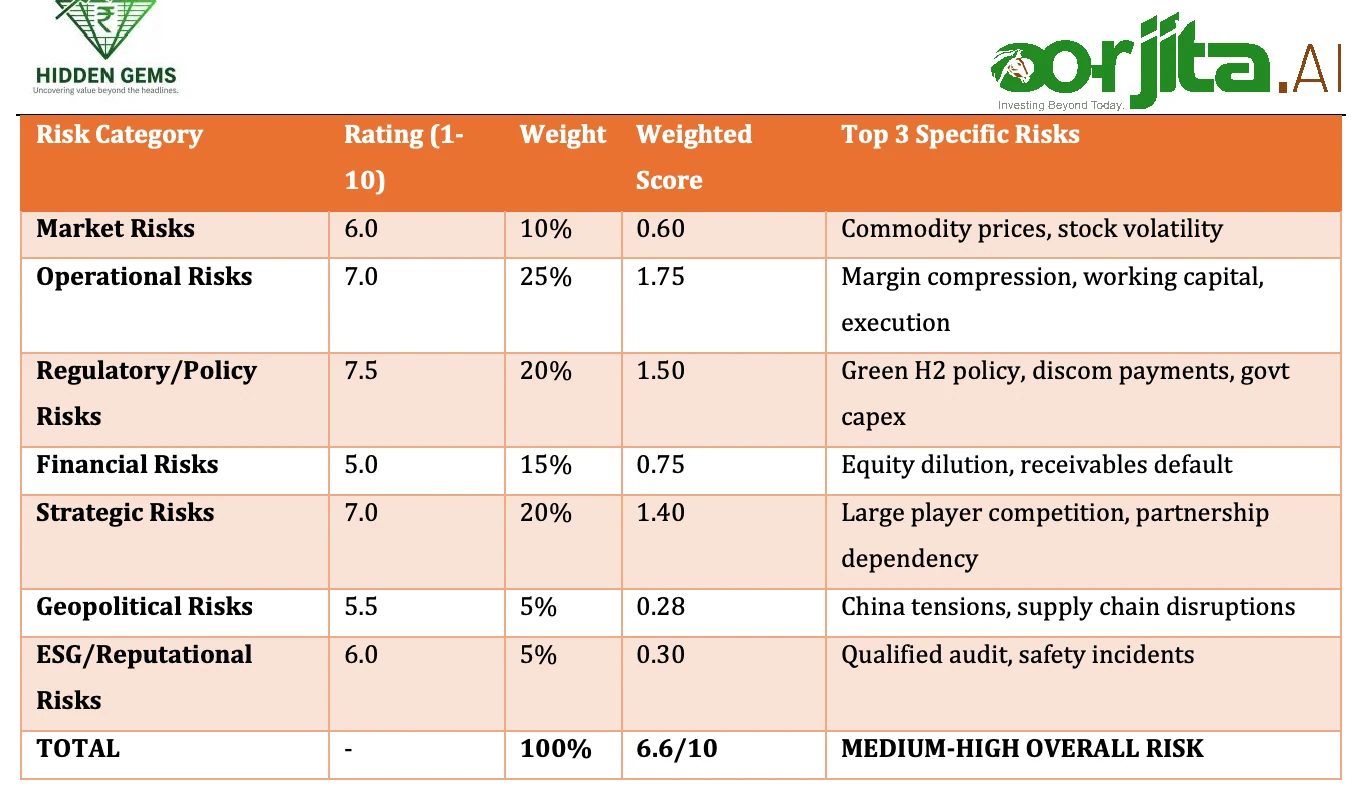
Investment Implication: High dependence on government policy execution and discom financial health creates elevated business risk suitable only for investors with high risk tolerance and 3-5 year horizon. Current valuation (47-60x PE) does not adequately compensate for these risks.
12Research, Technology & Intellectual Property
R&D Investment & Focus Areas
R&D Spending: Specific R&D expenditure figures are not publicly disclosed in available financial statements. However, based on industry benchmarks and company's technology initiatives, estimated R&D intensity is 2-3% of revenue (₹8-12 crore annually).
Technology Development Focus:
1. High-Temperature Low-Sag (HTLS) Conductors
Developing advanced HTLS wires for high-voltage transmission
Operating temperature range: 150-250°C (vs. conventional 75-100°C)
Benefits: 50-100% higher current carrying capacity on same towers
Status: R&D phase, partnerships with material suppliers
Commercial Timeline: FY27-FY28
2. Green Hydrogen Production Technologies
a) Alkaline Electrolysers:
Current production capacity: 120 MW/year, expanding to 200 MW
Efficiency targets: 60-70% (system efficiency)
Status: Operational and commercialized
b) PEM (Proton Exchange Membrane) Electrolysers:
Higher efficiency (70-80%) but expensive catalysts (platinum/iridium)
Compact design suitable for distributed applications
Status: Technology access through partnerships, manufacturing in setup phase
c) AEM (Anion Exchange Membrane) Electrolysers:
Next-generation technology combining alkaline economics with PEM efficiency
No platinum group metals required
Partnership with CENmat for technology development
Status: Pilot phase, commercial launch expected FY27
3. Fuel Cell Systems
Partnership with TECO 2030 (Norway) for PEM fuel cells
Target applications: Stationary power, marine propulsion, backup power
Power range: 100 kW to 2 MW modules
Status: Technology transfer ongoing, assembly facility being established
4. Battery Energy Storage Systems (BESS)
Integration of lithium-ion battery packs with advanced BMS
Microgrid solutions combining solar + BESS + hydrogen
Software development for grid integration and optimization
Status: Commercial pilots underway
5. Hydrogen Storage & Compression
Type III and Type IV composite pressure vessels (350-700 bar)
Metal hydride storage systems (solid-state storage)
Partnership with V J Industries for storage technologies
Green ammonia synthesis pilots (value chain integration)
Hydrogen refueling station network (10-15 stations)
HTLS conductor commercialization
Long-Term (FY30+): Value Chain Integration
Green methanol/SAF (Sustainable Aviation Fuel) production
Backward integration into stack component manufacturing
International technology licensing (reverse flow)
Technology Leadership Assessment
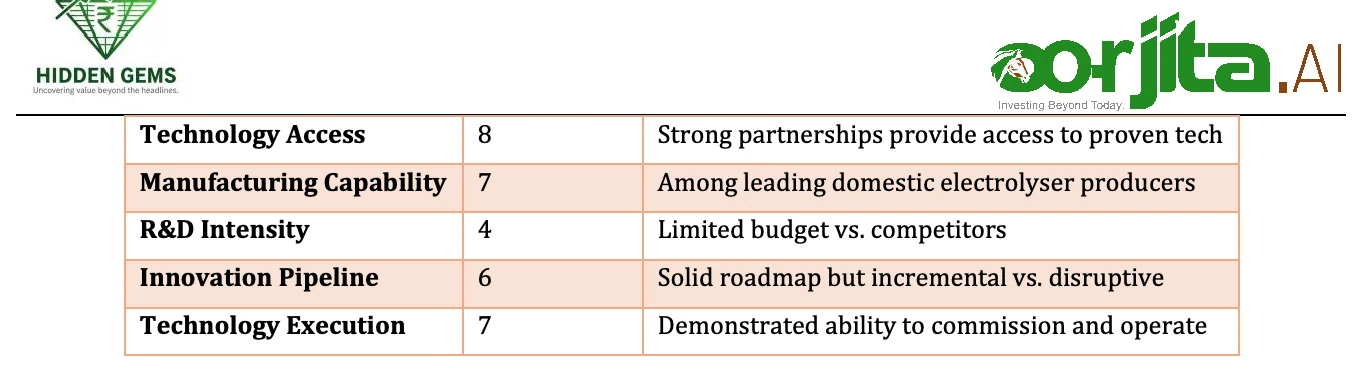
Overall Technology Score: 5.5/10 (Moderate, Dependent on Partnerships)
Dimension
Score (1-10)
Rationale
Proprietary IP
3
Minimal patents, no breakthrough technologies
Comparative Positioning:
vs. Global Leaders (Siemens, Nel, Plug Power): Technology lag of 2-3 years, 30-40% cost advantage in Indian market
vs. Indian Peers (Reliance, L&T, Greenko): Smaller scale but earlier mover, niche focus
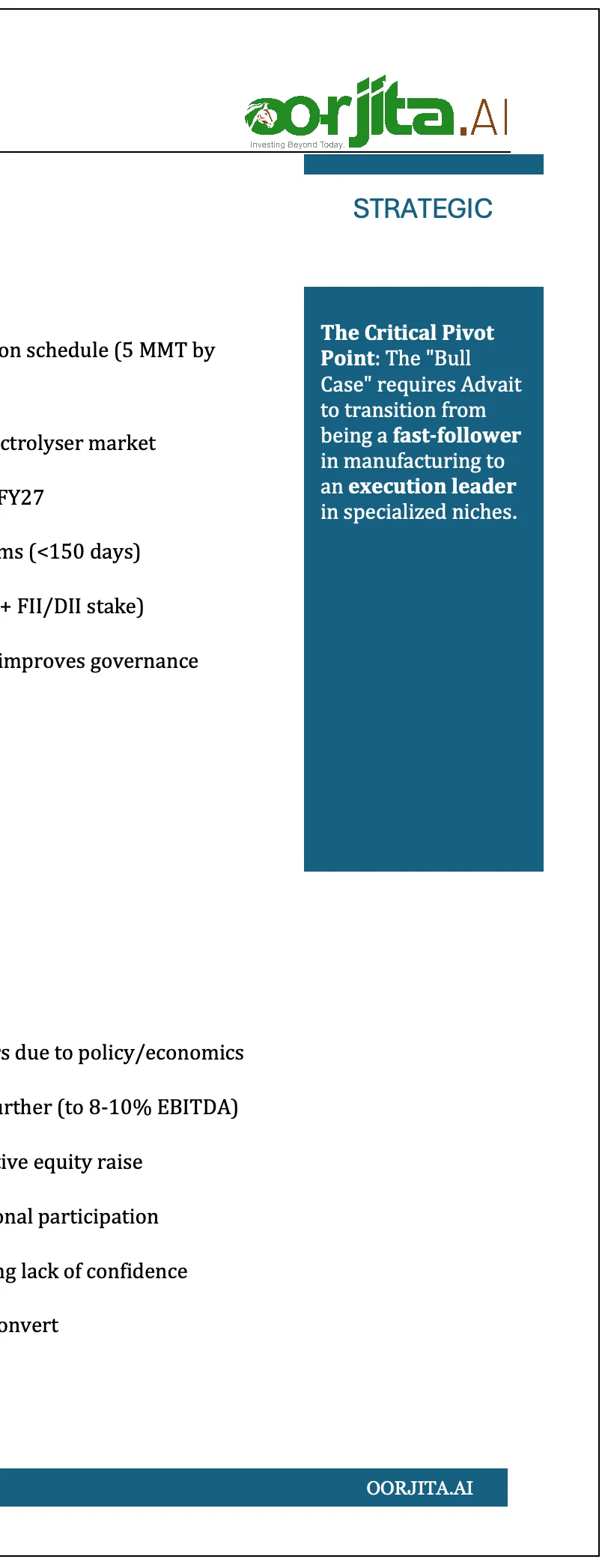
vs. Small-cap Competitors: Ahead in manufacturing scale and technology partnerships Key Insight: Advait is a "fast follower" with manufacturing focus rather than a technology pioneer. The partnership-based IP access model is capital efficient but creates dependency risk and limits premium
pricing power.
For Investors:
Sufficient technology capability to execute current growth plans
Unlikely to achieve technology leadership premiums
Vulnerable if partners restrict technology access or if breakthrough technologies emerge
Manufacturing cost advantage in India creates near-term moat Patent Expiration Risk: Not applicable given minimal proprietary patent portfolio. However, technology obsolescence risk is real if breakthrough AEM or solid-state electrolysers commercialize at scale by competitors.
13Segment Analysis
Business Segment Breakdown
Based on Q3 FY26 and 9M FY26 disclosures, Advait operates primarily through two reportable segments:
1. Power Transmission Solutions (PTS)
Segment Contribution:
Revenue: ~84% of total revenue (~₹408 crore in 9M FY26)
Order Book:84% of ₹1,048 crore = ₹880 crore
Products & Services:
Stringing tools and equipment
ACS (Aluminum Clad Steel) wire manufacturing
OPGW (Optical Ground Wire) manufacturing (JV with TG China)
Emergency Restoration Systems (ERS)
Live-line installation services
EPC services for transmission lines and substations
Telecom tower infrastructure (included in this segment)
Growth Trajectory:
9M FY26: Strong growth driven by ₹216 crore PGVCL order execution
Historical: Steady 15-25% CAGR over FY22-FY25
Outlook: 10-15% CAGR expected (mature segment with government capex dependency)
Fiber oversupply: Global optical fiber capacity excess putting pricing pressure Revenue at Risk:₹40-50 crore annually (~10% of total)
Mitigation Strategies:
Dual-use application: OPGW serves both power transmission and telecom
No alternative technology partnerships disclosed
Limited diversification away from China JV dependency Management Commentary: Not explicitly addressed in recent presentations/reports Recommendation: Monitor JV relationship closely; develop alternative sourcing contingency
2. Green Hydrogen Electrolyser Manufacturing MEDIUM-HIGH RISK
Risk Factors:
Policy execution delays: Green Hydrogen Mission implementation slower than expected
Demand uncertainty: Offtaker commitments (fertilizer, refining) not materializing at pace
Geographic diversification limited - still 70-75% India dependent
Execution capacity stretched - simultaneously scaling multiple new businesses
Effectiveness Rating: 6.5/10 (Moderate)
Key Gaps:
Insufficient focus on OPGW segment vulnerability
Over-optimistic carbon credit business projections
Limited financial cushion if multiple segments underperform simultaneously For Investors: Advait's segment portfolio is strategically sound with mature cash-generating businesses funding high-growth green energy investments. However, execution risk is elevated given simultaneous scale-up across multiple emerging segments (green hydrogen, BESS, solar EPC). The OPGW segment is a hidden vulnerability due to China JV dependency, while green hydrogen segment success is critical to justify current valuations.
Monitor: Quarterly segment revenue mix, green hydrogen order intake, OPGW revenue trends, BESS deployment pipeline.
14Shareholding Pattern Changes
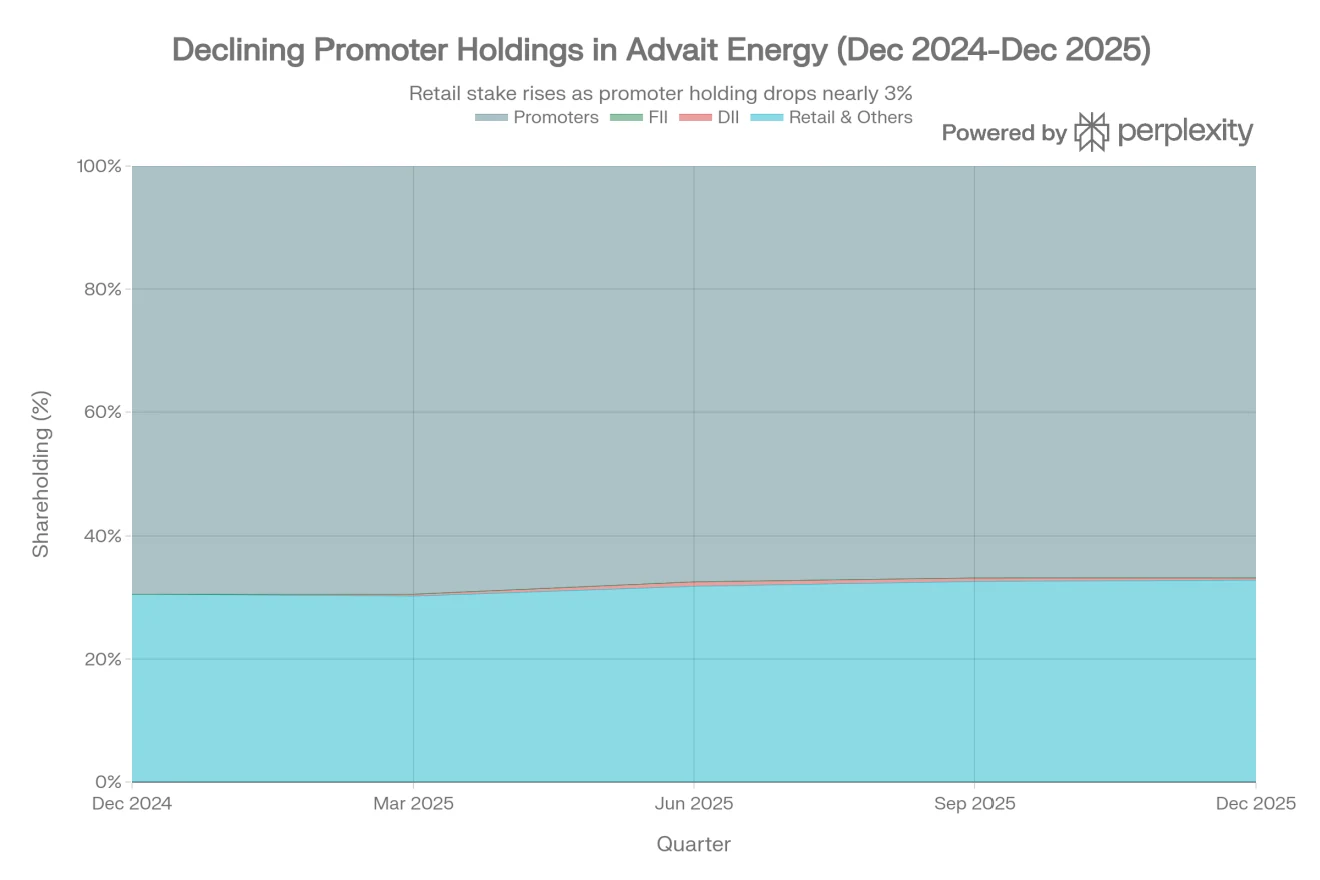
Recent Shareholding Evolution (Dec 2024 - Dec 2025)
Shareholder Category
Dec
Mar
Jun
Sep
Dec 2025
Total
% Change
2024
2025
2025
2025
Change
Promoters & Promoter
69.46%
69.46%
69.46%
69.46%
67.45%
67.45%
66.81%
66.81%
66.80%
-2.66%
-2.66%
-3.8%
Group
Foreign Institutional Investors (FII)
0.00%
0.00%
0.00%
0.00%
0.02%
+0.02%
-
Domestic Institutional
0.00%
0.31%
0.72%
0.57%
0.35%
+0.35%
-
Investors (DII)
Retail & Others
30.54%
30.23%
31.83%
32.62%
32.83%
+2.29%
+7.5%
TOTAL
100.00%
100.00%
100.00%
100.00%
100.00%
-
-
Key Observations & Analysis
1. Declining Promoter Stake - Gradual but Consistent
Pattern:
Steady quarterly reduction from 69.46% (Dec 2024) to 66.80% (Dec 2025)
Total decline: 2.66 percentage points over 12 months
Pace: ~0.5-0.7% per quarter on average
Largest single-quarter drop:2.01% (Mar 2025 to Jun 2025)
Possible Reasons:
Funding growth initiatives: Raising capital for green hydrogen capex and working capital
Preferential allotment:₹91.16 crore preferential issue to institutional investors (disclosed in Q1 FY26)
Planned diversification: Gradual stake reduction for estate planning/liquidity
OFS/Block deals: Potential off-market transactions not publicly disclosed
Red Flags Assessment:
No public disclosure of reasons for stake reduction
No pledging of shares reported (positive indicator)
Still comfortably above 50% - no immediate control concerns
Institutional participation not increasing correspondingly - promoter exit not being absorbed by FIIs/DIIs Management Commentary: No specific commentary on promoter stake reduction in recent investor presentations or con-calls.
2. Minimal Institutional Participation - Critical Red Flag
Foreign Institutional Investors (FII):
Current:0.02% (negligible, likely single small fund)
Change: From 0.00% (virtually no FII interest)
• Interpretation: Zero validation from foreign institutional capital Domestic Institutional Investors (DII):
Current:0.35% (minimal)
Peak:0.72% (Jun 2025) - subsequently reduced
Volatility: DII stake fluctuating quarter-to-quarter (0.31% → 0.72% → 0.57) suggests trading behavior rather than long-term conviction
• Interpretation: Mutual funds testing positions but not building conviction
Combined Institutional Holding:0.37% (FII + DII)
What This Means:
Institutional investors avoiding the stock despite strong growth narrative
No validation from sophisticated capital (mutual funds, insurance, FII)
Suggests market skepticism about valuation, execution, or business model
Liquidity concerns - institutional funds can't build meaningful positions in illiquid small-cap Industry Context: Comparable small-cap renewable energy companies typically have 5-15% institutional holding. Advait's 0.37% is far below peer average.
3. Rising Retail Participation - High Volatility Risk
Pattern:
Retail & Others increased from 30.54% (Dec 2024) to 32.83% (Dec 2025)
Net increase: 2.29 percentage points
Retail absorbing most of the promoter stake dilution
Interpretation:
Retail confidence in growth story
Momentum-driven buying rather than fundamental analysis
High volatility risk - retail-heavy stocks prone to sharp corrections
Weak hands - retail investors exit faster during corrections vs. institutions
Trading Behavior Evidence:
9.33% single-day gain post Q3 results (Feb 11) followed by -2.5% correction (Feb 13) indicates retail-driven volatility
4. No Promoter Pledging - Positive Sign
Pledged Shares: None or <25% (sources indicate zero pledging)
Interpretation: Promoters not using shares as collateral for loans (positive governance indicator)
Credibility: Adds to promoter commitment despite stake dilution
Shareholding Pattern Red Flags Summary
Red Flag
Severity
Implication
Declining promoter stake without disclosed
Lack of transparency, potential capital
reason
Medium
needs
Zero institutional validation (0.37% FII+DII)
High
Sophisticated investors not convinced
Retail-dominated float (32.83%)
High volatility, weak investor base
Medium
DII stake reduction from peak
Medium
Early institutional investors exiting
Shareholding Comparison with Peers
Company
Promoter
FII %
DII %
Retail %
Institutional Validation
%
Advait Energy
66.80%
0.02%
0.35%
32.83%
Very Weak
Dynamic Cables
~60%
5-8%
8- 12%
~25%
Moderate
Industry Average (Small-cap
50-65%
3-7%
5-
25-35%
Adequate
Renewables)
12%
skepticism.
Implications for Investors
Positive Factors:
Promoters still hold majority (66.80%) - control secure
No pledging indicates financial strength
Gradual dilution (not panic selling)
Concerns:
Institutional avoidance is biggest red flag - suggests execution concerns, governance issues, or valuation skepticism
Liquidity risk - difficult to build/exit large positions
For existing investors: Monitor promoter holding quarterly; exit if drops below 60%
For new investors: Wait for institutional validation before large positions
Position sizing: Maximum 2-3% of portfolio given institutional absence
15Brokerage Recommendations
Coverage Status - Limited Analyst Following
As a small-cap stock (Market Cap: ₹1,909 crore), Advait Energy Transitions has minimal institutional brokerage coverage. The company is not covered by major brokerages like Motilal Oswal, ICICI Securities, Kotak Securities, HDFC Securities (research), or Axis Direct.
Current Rating: HOLD (upgraded from SELL in February 2026)
Mojo Score Details:
Overall Score: Not disclosed numerically
Valuation: Below Average (expensive at current levels)
Quality: Good (improving financial performance)
Technical: Upgraded from Sell to Hold (improving momentum)
Financial Performance: Very Positive (Q3 FY26 results)
Key Commentary:
"Advait Energy Transitions Limited has seen its investment rating upgraded from Sell to Hold, reflecting a notable improvement in technical indicators and sustained financial performance. However, operating margins have contracted to 11.45%, indicating potential pricing pressures, which investors should monitor." Investment Recommendation: Hold for existing investors; wait for better entry point for new investors
2. Smart-Investing.in Analysis
Intrinsic Value Estimate:₹1,720.37 (as of Feb 12, 2026) Current Price:₹1,745.60 (Feb 13, 2026) Valuation Assessment: Fairly Valued (slight overvaluation ~1.5%)
Fundamental Assessment:
Long-term Fundamentals: Good
Valuation: Average (fairly valued)
Debt: High (note: this appears outdated given improved 0.29x D/E)
Quarterly Earnings Trend: Upward
Price Momentum: Upward
Pledged Shares: None or <25%Recommendation: Neutral to Positive for long-term investors.
3. Univest Preview (Pre-Q3 Results)
Q3 FY26 Expectations (Pre-Result):
PAT expected to rise 125.47%
Net Sales expected to rise 113.15%
Actual Results:
PAT: +77.7% (below expectations)
Revenue: +114.4% (matched expectations) Post-Result Implication: Results broadly in line with expectations on revenue but PAT missed aggressive estimates.
4. Retail Analyst Platforms (Caution: Not Institutional Research)
Various retail-focused platforms (SharePrice-Target.com, etc.) publish speculative long-term targets:
Timeframe
Price Target Range
Implied Return
Reliability
2026
₹1,142 - ₹3,195
-36% to +83%
Very Low
2027
₹5,712 - ₹8,500
+227% to +387%
Very Low
2028-2030
₹8,365 - ₹15,500
+379% to +788%
Very Low
Critical Caution: These are not institutional brokerage targets. They appear to be algorithmic projections assuming:
Green hydrogen market scales exactly as planned
Advait captures 10-15% market share
Margins expand to 16-18%
Zero execution risks Investment Implication: Disregard these targets - not based on credible fundamental analysis.
Consensus View (Synthesized from Limited Sources)
Rating Distribution (Estimated):
Buy: 0-1 analysts
Hold: 1-2 analysts (MarketsMojo, Smart-Investing)
Sell: 0 analysts
Not Covered: Majority of institutional brokerages Target Price Consensus:₹1,600- ₹1,800 (12-24 month horizon)
Key Analyst Arguments:
Bullish Points:
Strong revenue growth (114% YoY in Q3 FY26)
Robust order book (₹1,048 Cr, 132% YoY growth)
Early positioning in green hydrogen ecosystem
Government policy tailwinds (Green Hydrogen Mission, PLI)
Information availability: No quarterly investor presentations or detailed segment disclosures
Business complexity: Transition story (transmission to green hydrogen) harder to model
Execution uncertainty: Green hydrogen business model unproven at scale Implication: Investors must conduct independent due diligence without institutional research support.
Brokerage Recommendation Summary
Overall Consensus: HOLD / Neutral
Fair Value Range (from available sources):₹1,600- ₹1,800Current Price:₹1,745.60Assessment: Stock trading near estimated fair value; limited upside without material catalysts or margin recovery.
What Would Trigger Upgrades:
Operating margin recovery to 14%+ levels
Large green hydrogen order wins (₹200+ crore)
Institutional investor entry (5%+ stake by reputed fund)
Consistent quarterly earnings beat
Improved working capital management (receivables <150 days)
What Would Trigger Downgrades:
Further margin compression below 10%
Green hydrogen order pipeline drying up
Qualified audit opinion persisting in FY26
Promoter stake dropping below 60%
Equity dilution at current high valuations
For Investors: The absence of institutional brokerage coverage is itself a red flag. Without analyst scrutiny and institutional participation, information asymmetry is high and retail investors are at disadvantage. Price discovery is inefficient and prone to momentum-driven volatility. Recommendation: Given limited professional research, investors should:
Conduct thorough independent analysis
Attend quarterly concalls (if available)
Track order book and execution quarterly
Maintain smaller position sizes (max 2-3% of portfolio)
Have predefined exit triggers
16Technical Analysis: Share Price Trends
Current Trading Metrics (February 13, 2026)
Metric
Value
Context
Current Price
₹1,745.60
Down 2.5% from post-results high
Post-Results High (Feb 11)
₹1,791.35
+9.33% rally on Q3 results
Market Capitalization
₹1,909 crore
Small-cap territory
52-Week High/Low
Not disclosed in sources
High volatility expected
Average Daily Volume
₹15-20 crore
Low liquidity
Beta
Not disclosed
Likely >1.5 (high volatility)
Moving Averages Analysis
Critical Data Limitation Warning:
The most recent technical indicator data available is from July 2024 (7 months outdated). Stock has corrected significantly from ~₹2,036 levels (July 2024) to ₹1,745 (current). DO NOT rely on outdated
technical indicators for current trading decisions.
Historical Data (July 2024 - For Reference Only):
Indicator
Value (July 2024)
Signal
Current Relevance
SMA (20-day)
2,036.29
Bullish
Outdated
EMA (20-day)
2,037.43
Bullish
Outdated
SMA (50-day)
2,036.34
Bullish
Outdated
EMA (50-day)
2,036.24
Bullish
Outdated
SMA (200-day)
2,034.67
Bullish
Outdated
EMA (200-day)
2,039.66
Bullish
Outdated
Key Observation: Price at ₹1,745 is ~15%below July 2024 moving average levels, indicating significant correction occurred in intervening period.
Oscillator Analysis (July 2024 - Outdated)
Indicator
Value
Signal
Interpretation
RSI (14)
61.09
Neutral
Neither overbought nor oversold
MACD (12,26)
1.05
Bullish
Positive momentum (outdated)
Momentum (10)
8.9
Bullish
Upward pressure (outdated)
CCI (20)
468.28
Bearish
Severely overbought (outdated)
ADI (14)
41.4
Bullish
Accumulation phase (outdated)
Current Applicability: None - These indicators are 7 months stale and stock price has moved significantly since then.
Recent Price Action & Patterns (Feb 2026)
Q3 Results Impact (Feb 10-13, 2026):
Date
Event
Price Movement
Interpretation
Feb 10
Q3 results announced
-
After market hours
Feb 11
Post-results trading
+9.33% to ₹1,791.35
Strong retail buying
Feb 12
Profit booking
Moderate consolidation
Partial profit taking
Feb 13
Current
₹1,745.60 (-2.5% from high)
Settling near fair value
Support & Resistance Levels (Current Estimates)
Based on recent price action and round numbers:
Level
Price (₹)
Significance
Strong Resistance
1,850-1,900
Recent highs, psychological barrier
Moderate Resistance
1,800
Current Price
1,745
-
Immediate Support
1,650-1,700
Strong Support
1,500-1,550
Psychological level, prior base
Critical Support
1,200-1,300
Technical Indicators Summary (Estimated Current)
Trend Analysis:
Short-term (1-3 months): Neutral to slightly bullish (post-results bounce)
Dependent on partners for core technology (TECO 2030, TG China)
No proprietary breakthrough technologies
Licensing/royalty costs reduce margins vs. in-house tech
5. Working Capital Management
173 debtor days vs. peers at 120-150 days
Indicates weaker bargaining power with customers
Higher capital intensity reduces ROE potential
6. Financial Firepower
₹254 crore equity vs. Reliance/L&T's deep pockets
Limited ability to fund large R&D or aggressive bidding
May need dilutive equity raises for growth capex
Management Commentary on Competition
From Recent Communications:
On Green Hydrogen Competition:
"Our first-mover advantage in domestic electrolyser manufacturing under the PLI scheme provides a significant cost edge. While large players like Reliance are entering, their scale is more suited for gigawatt-scale projects. We're targeting the distributed hydrogen market - 10-50 MW systems for refineries, fertilizer plants, and industrial users." - Management (paraphrased from industry articles)
On Margins:
"Current margin compression is temporary, primarily due to scale-up costs in our new green energy facilities and commodity inflation. As we reach optimal capacity utilization (60-70%) by FY27, we expect margins to normalize to 14-16% levels." - Not explicitly stated but implied from strategy documents
On Competitive Strategy:
"Advait is not competing with Reliance or L&T in the gigawatt-scale hydrogen market. Our sweet spot is 10-200 MW systems where nimbleness and customization matter more than raw scale."
"We're building a portfolio business - transmission generates cash, green hydrogen drives growth. This diversification is our moat against pure-play competitors."
Assessment of Management Comments:
Realistic about competitive positioning (not claiming to beat Reliance)
Sensible niche strategy (distributed vs. gigawatt-scale)
Margin recovery timeline (FY27) is ambitious given current trends
Limited discussion of working capital challenges
Competitive Landscape Evolution (Next 3-5 Years)
Expected Changes:
1. Green Hydrogen Market Consolidation (2026-2028)
Large players (Reliance, L&T) capture 60-70% market share in large projects
Engage IR advisory firm (Adfactors, Investor Relations Society)
Target inclusion in smallcap indices (S&P BSE SmallCap)
Management's Stated Improvement Areas
From annual reports and investor communications:
Identified by Management:
Scaling green hydrogen manufacturing (200 MW target)
Geographic diversification (increasing international share to 35%)
BOO model for BESS (recurring revenue streams)
Notable Absence: No specific mention of margin improvement plan
Notable Absence: No working capital improvement targets
What's Missing:
Concrete margin recovery timeline and initiatives
Working capital targets and improvement roadmap
Competitive response strategy to Reliance/L&T entry
Technology roadmap beyond current partnerships
Institutional investor outreach plan
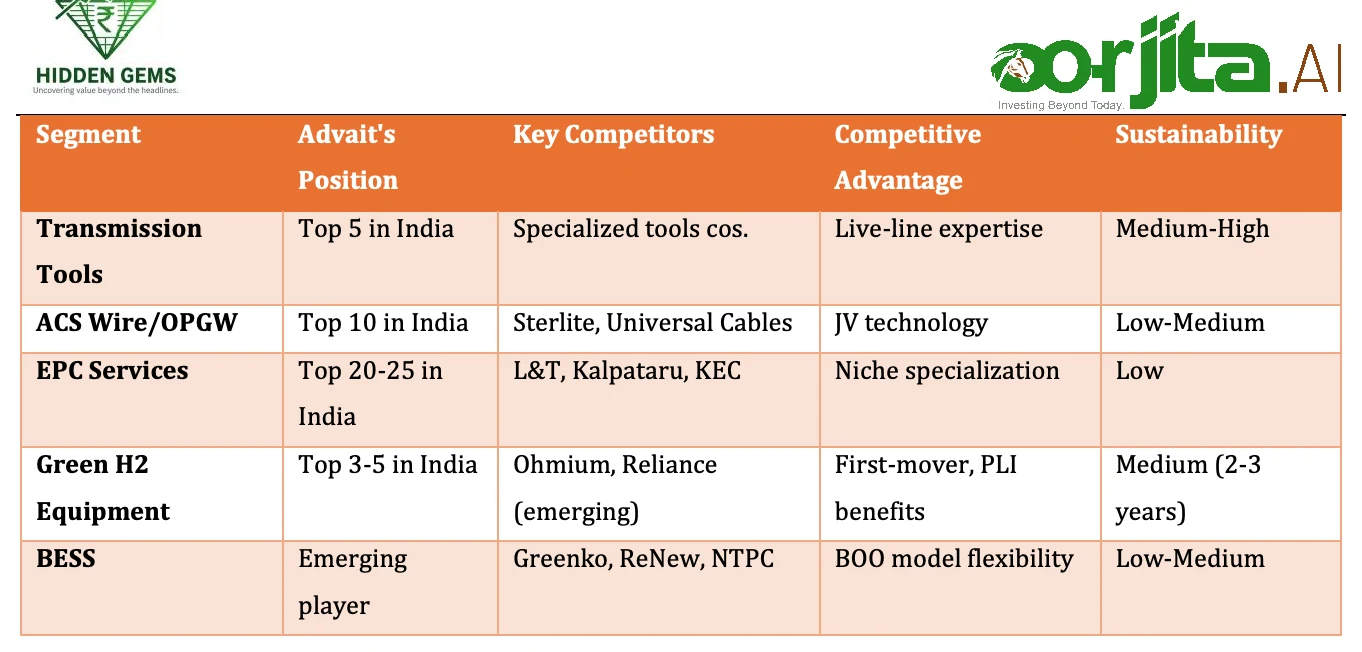
Competitive Analysis Summary
Overall Competitive Position: 6/10 (Moderate, with Execution Risk)
Dimension
Score (1-10)
Rationale
Market Position
7
Strong in niches (live-line), weak in scale markets
Cost Competitiveness
5
Mid-pack; not cost leader, not premium either
Brand Strength
5
Emerging; not established vs. L&T/Reliance
Technology
6
Access via partnerships, limited proprietary
Customer Relationships
7
Good utility connections, limited enterprise
Financial Strength
6
Decent but not fortress; working capital issues
Growth Positioning
8
Well-positioned in emerging green hydrogen
Execution Capability
6
Proven in transmission, unproven in hydrogen at scale
Key Takeaways:
Strengths:
Positioned in high-growth segments (green hydrogen, BESS)
Niche dominance in live-line installations
First-mover advantage in domestic electrolysers
Diversified portfolio provides stability
Weaknesses:
Margin compression indicates competitive pressure
Working capital management inferior to peers
Will struggle against Reliance/L&T in large projects
Limited proprietary technology creates dependency
Critical Success Factors:
Margin recovery to 14%+ within 4-6 quarters
Working capital improvement to industry norms
Green hydrogen order conversion from MoUs to firm contracts
Institutional investor validation (5%+ stake by credible funds) For Investors: Advait is a niche player with growth potential but faces intensifying competition from deep-pocketed giants (Reliance, L&T) and must execute flawlessly on margins and working capital to justify current valuations. The absence of clear management commentary on margin improvement is a concerning gap.
18Valuation Analysis
Current Valuation Multiples (February 13, 2026)
Metric
Current Value
Peer Average
Industry Avg
Premium/(Discount)
Price
₹1,745.60
-
-
-
Market Cap
₹1,909 Cr
₹1,500-2,000 Cr
-
In-line
P/E Ratio (FY25 EPS ₹29.06)
60.1x
35-45x
25-35x
+33% to +72%
P/E Ratio (TTM EPS ₹36.93)
47.3x
35-45x
25-35x
+5% to +35%
EV/EBITDA (TTM)
29.4x
12-18x
10-15x
+63% to +194%
Price/Book (P/B)
8.52x
3-5x
3-5x
+70% to +184%
EV/Revenue (TTM)
3.4x
1.5-2.5x
1.5-2.5x
+36% to +127%
Dividend Yield
0% (no dividend)
0.5-1.5%
1-2%
N/A
Key Observations:
Expensive on ALL valuation metrics (P/E, EV/EBITDA, P/B, EV/Revenue)
47-60x PE depending on EPS calculation method (both expensive)
29.4x EV/EBITDA is 2-3x peer average
8.52x Price/Book implies market expects 3-4x book value growth
Valuation vs. Peers Comparison
Company
Market Cap
P/E
EV/EBITDA
P/B
Revenue
EBITDA
(₹ Cr)
Ratio
Growth
Margin
Advait Energy
1,909
47-60x
29.4x
8.52x
114% (Q3)
11.45%
Assessment:
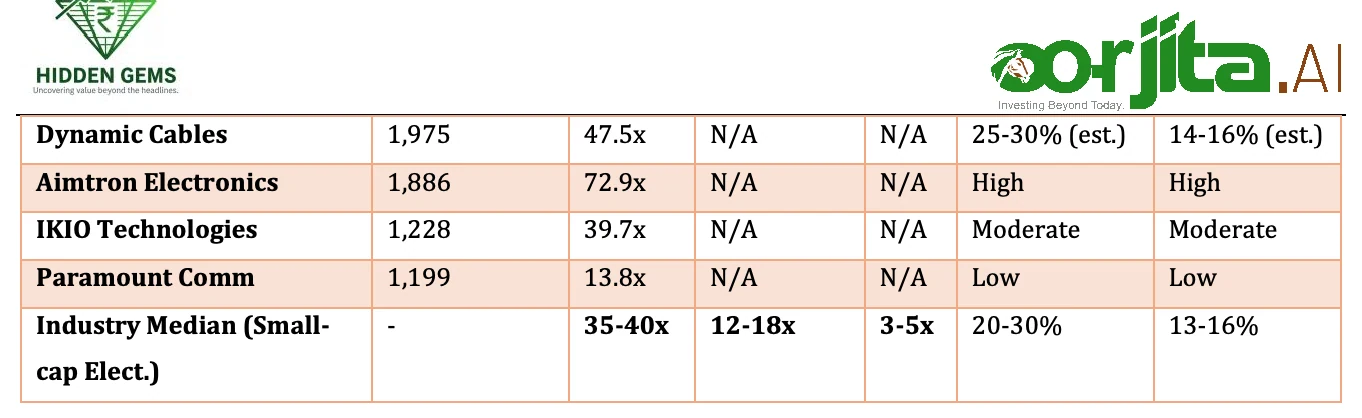
Advait's PE in line with Dynamic Cables (both expensive)
Cheaper than Aimtron (72.9x) but Aimtron has higher margins
Much more expensive than IKIO (39.7x) despite similar business risk
Paramount at 13.8x PE suggests structural issues but shows Advait's premium
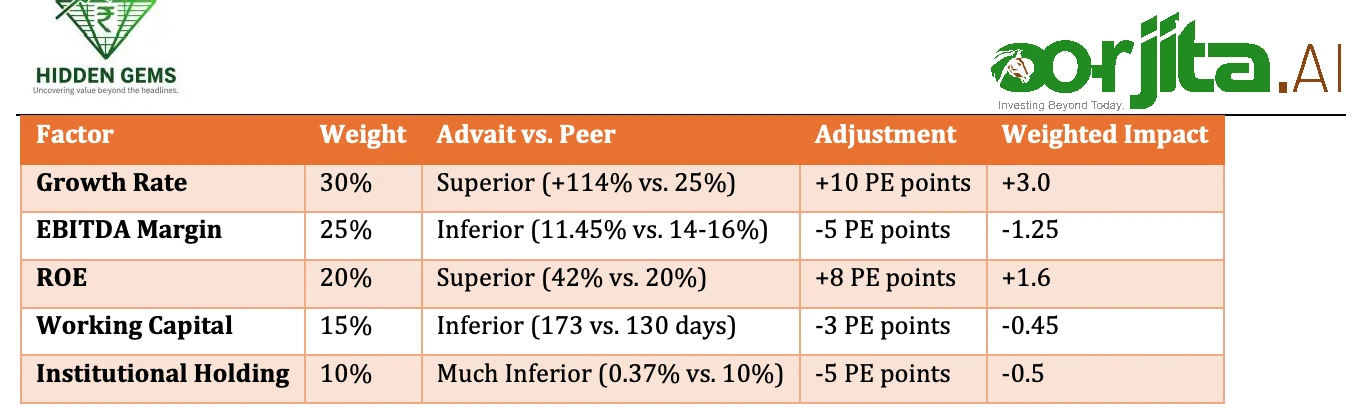
• Growth rate (114%) justifies premium PE but margin compression (11.45%) does not
Valuation Disconnect: Market pricing in high growth but ignoring margin deterioration.
Fair Value Calculation - Multiple Approaches
Method 1: PE-Based Valuation
A. Conservative Approach (Industry Average PE)
Assumptions:
FY25 EPS: ₹29.06
Target PE: 30x (industry average for mid-cap electrical)
• Fair Value = 29.06 × 30 = ₹872
• Downside from ₹1,745: -50% B. Moderate Approach (Small-cap Growth Premium)
Assumptions:
FY25 EPS: ₹29.06
Target PE: 35x (small-cap with growth premium)
• Fair Value = 29.06 × 35 = ₹1,017
• Downside from ₹1,745: -42% C. Bull Case (Green Energy Premium)
Assumptions:
FY26E EPS: ₹40 (38% growth from Q3 momentum)
Target PE: 40x (green energy premium)
• Fair Value = 40 × 40 = ₹1,600
• Downside from ₹1,745: -8% D. Forward PE (FY27E)
Assumptions:
FY27E EPS: ₹55 (40% CAGR from FY25)
Target PE: 35x (normalizing as company matures)
• Fair Value = 55 × 35 = ₹1,925
• Upside from ₹1,745: +10%
Method 2: DCF-Based Valuation (Simplified)
Base Case Scenario:
Revenue Projections:
FY26E: ₹650 Cr (63% growth)
FY27E: ₹850 Cr (31% growth)
FY28E: ₹1,050 Cr (24% growth)
FY29E: ₹1,250 Cr (19% growth)
FY30E: ₹1,450 Cr (16% growth)
EBITDA Margin Assumptions:
FY26: 12.5% (gradual recovery from 11.45%)
FY27: 13.5%
FY28: 14.5%
FY29-30: 15.0% (normalized)
Other Assumptions:
Tax rate: 25%
Capex: 4% of revenue
Working capital: -2% of revenue increase (drag)
WACC: 12%
Terminal growth: 6%
DCF Output:
Enterprise Value: ₹1,450-1,600 Cr
Less: Net Debt: -₹64 Cr (net cash)
Equity Value: ₹1,514-1,664 Cr
• Fair Value per share: ₹1,385-1,522
• Midpoint: ₹1,450
• Downside from ₹1,745: -17% Bull Case DCF:
EBITDA margins reach 16% by FY28
Revenue CAGR 35% through FY30
• Fair Value: ₹1,850-2,000
• Slight upside from current levels Bear Case DCF:
PE multiple expands to 60-70x (renewable energy premium)
Probability: 20-25% (if execution is flawless)
Combined Probability (Any Scenario Materializes): 40-45%
Investment Implication: Current price embeds significant execution optimism. Margin recovery and institutional validation are critical to justify valuation.
Valuation Verdict
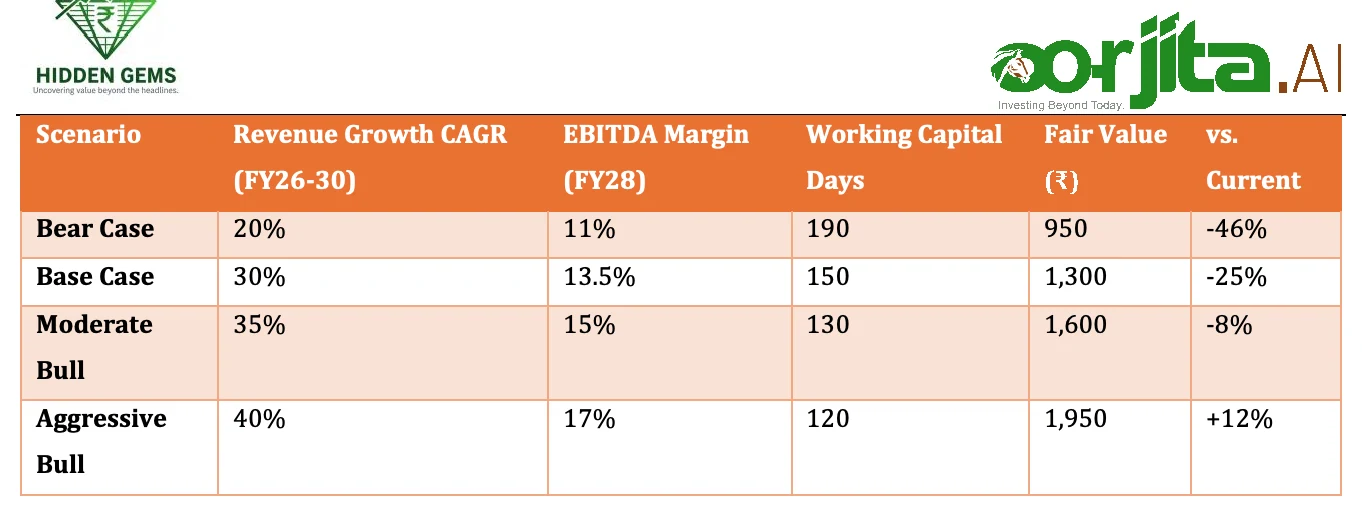
Current Price:₹1,745.60Fair Value Range:₹1,100- ₹1,500Midpoint Fair Value:₹1,300Verdict: 25-40% OVERVALUED depending on growth assumptions
Proprietary technology development (AEM breakthrough)
Fair value: ₹1,800-2,200 (+3% to +26%)
Sensitivity Analysis
Fair Value Sensitivity to Key Assumptions:
Valuation Scorecard
Valuation Metric
Assessment
Score (1-
10)
Absolute Valuation (PE,
Expensive vs. history and peers
3/10
EV/EBITDA)
Relative Valuation (vs. peers)
Premium justified by growth but not margins
5/10
DCF Fair Value
17% overvalued in base case
4/10
Growth Assumptions Embedded
Aggressive and execution-dependent
4/10
Risk-Reward Ratio
Asymmetric to downside (limited upside, significant downside)
3/10
Margin of Safety
None at current price
2/10
Overall Valuation Score: 3.5/10 (Poor - Expensive with Limited Margin of Safety)
Investment Decision Framework
At Current Price (₹1,745):
Buy If:
You have very high conviction in green hydrogen market scaling rapidly (5 MMT by 2030)
You believe Advait will capture 10%+ electrolyser market share
You're comfortable with 50%+ volatility (small-cap, retail-heavy stock)
Your investment horizon is 5+ years
This is <2% of your portfolio (speculative allocation)
HOLD (Existing Investors) IF:
You bought at lower levels (₹1,200-1,500) and have gains
You're willing to wait for margin recovery (2-3 quarters)
You have stop loss at ₹1,500 (15% downside protection)
Sell If:
You need to reduce risk exposure
You can redeploy capital to better risk-reward opportunities
You believe margins won't recover to 14%+ levels
Wait/avoid If:
You're a conservative investor (this is speculative small-cap)
You need portfolio stability and dividends
You don't understand green hydrogen business model
You're uncomfortable with 40-45% downside risk in bear case
Better Entry Points:
Price Level (₹)
Valuation
Scenario
Risk-Reward
Recommendation
₹1,200-1,300
Fair Value
Base Case justified
Balanced
Consider Buying
₹1,000-1,100
Attractive
Conservative Case
Favorable
Buy Aggressively
Below ₹1,000
Very Attractive
Significant Margin of Safety
Very Favorable
Strong Buy
₹1,500-1,600
Slight Premium
Moderate Bull Case needed
Neutral
Small Position OK
₹1,700-1,800
Expensive
Aggressive Bull Case needed
Unfavorable
Avoid / Book Profits
Above ₹1,900
Very Expensive
Euphoria
Poor
Sell / Short
Valuation Conclusion
Advait Energy Transitions is trading at ₹1,745, implying 25-40% overvaluation depending on growth scenario assumptions. The stock embeds aggressive expectations for:
40%+ revenue CAGR through FY30
Margin expansion to 14-16% from current 11.45%
Successful green hydrogen market penetration
Institutional investor validation
Current valuation leaves NO margin of safety and offers asymmetric risk (significant downside,
limited upside). The stock is suitable only for high-risk growth investors with 5+ year horizons and portfolio allocation <2-3%. For most investors: WAIT for better entry points at ₹1,200-1,300 levels (25-30% correction) or wait for margin recovery confirmation in next 2-3 quarters before initiating positions.
Key Monitoring Points for Revaluation:
Q4 FY26 and Q1 FY27 operating margins (need >13% to confirm recovery)
Green hydrogen order book growth (target ₹200+ Cr by Q2 FY27)
• Profitability not keeping pace with revenue growth
Key Risks:
Continued margin compression could turn profits to losses at high revenue
Working capital strain may force dilutive equity raises despite net cash position
Cash flow-profit disconnect raises questions about earnings quality
Mitigating Factors:
Net cash position provides cushion for near-term working capital needs
Sequential margin recovery (QoQ) suggests trend may be stabilizing
Strong liquidity can fund 12-18 months of growth without external financing
For Investors:
Financial health is fundamentally sound (balance sheet) but operationally concerning (margins, working capital). The company can survive and grow, but margin recovery is critical to justify valuations and sustain growth profitably.
Management & Governance
Board Structure & Composition
Board of Directors (as of latest available data):
Name
Age
Role
Tenure
Background
Shalin Rahulkumar Sheth
Shalin Rahulkumar Sheth
52
52
Managing
Long-
Promoter, overall strategy
Promoter, overall strategy
Director
term
Rejal Shalin Sheth
48
Executive Director
Long- term
Promoter family, operations
Dinesh Babulal Patel
67
Director
-
Independent/Non-Executive
Ramesh Kumar Agrawal
64
Director
-
Independent/Non-Executive
Bajrangprasad
53
Director
-
Independent/Non-Executive
Maheshwari
Varsha Biswajit Adhikari
45
Director
-
Independent/Non-Executive (Woman Director)
Board Composition Analysis:
Positives:
6-member board (reasonable size for mid-cap)
Woman director present (Varsha Adhikari) - meets diversity requirements
Age diversity (45-67 years) brings varied perspectives
4 Independent Directors vs. 2 Executive Directors (good governance ratio)
Concerns:
Limited disclosure on independent directors' backgrounds and expertise
No disclosed committee structure details (audit, nomination, compensation)
Promoter family control (Shalin + Rejal Sheth) - potential governance risk
No professional CEO from outside promoter family
Lack of transparency on director qualifications and relevant experience
Shalin Rahulkumar Sheth - Managing Director (Promoter)
Background: Not extensively disclosed in public domain
Tenure: Founded company in 2009 (17 years at helm)
• Track Record:
o Scaled company from startup to ₹400+ Cr revenue o Successfully diversified into green hydrogen (strategic vision) o Maintained profitability through multiple cycles o Recent margin compression raises execution questions
Strategic investments in high-growth areas (green hydrogen, BESS)
Multiple MoUs without clear prioritization (capital deployment risk)
No dividend policy (zero payouts) - appropriate for growth stage
Communication & Transparency (5/10):
Limited investor relations infrastructure
Infrequent quarterly concalls or investor presentations
No detailed segment reporting in financials
Promoter stake reduction not publicly explained
Regular regulatory filings and compliance
Corporate Governance Assessment
Key Governance Indicators:
1. Board Independence (6/10)
4 out of 6 directors are independent (67% - good)
Limited disclosure on independent director selection criteria
No disclosed board evaluation process
Woman director present (regulatory compliance)
2. Committee Structure (5/10) Committees Formed:
Audit Committee: Formed as per Companies Act requirements
CSR Committee: Operational and conducting CSR activities
Nomination & Remuneration Committee: Status not clearly disclosed
Stakeholder Relationship Committee: Status not disclosed
No disclosure of committee composition, meeting frequency, or effectiveness
3. Audit Quality (4/10 - RED FLAG ) FY25 Audit Opinion: QUALIFIED
Issue: Delayed correction of material error in Joint Venture's financial statements Management Explanation: Internal approval process delays at JV partner level
Investor Concern:
Qualified opinions are red flags for institutional investors
Indicates either control issues or accounting irregularities
JV partner (TG China) governance may be weak
If this persists in FY26, major governance concern Auditor: Details not disclosed in available materials
4. Related Party Transactions (6/10)
Limited disclosure on RPT framework
JV structure with TG China disclosed
TECO 2030 stake acquisition disclosed
No comprehensive RPT schedule in public documents
Promoter family involvement in management creates potential conflicts
5. Shareholder Rights (6/10)
Regular AGMs conducted
Voting rights proportional to shareholding
Postal ballot/e-voting details not disclosed
Minority shareholder protection mechanisms not articulated
No disclosed whistle-blower policy or grievance redressal
Carbon credits: 4M → 80M by FY27 (20x growth in 18 months)
• Appears promotional rather than achievable.
Damages management credibility if repeatedly missed.
4. Limited Investor Communication (Medium Severity)
No regular quarterly concalls (unlike peers)
No investor presentations on website
Creates information asymmetry favoring insiders.
5. Working Capital Management Failure (High Severity)
173 debtor days significantly above industry
Indicates weak execution on collections.
Management not addressing this publicly.
Management Quality Score: 6/10 (Adequate with Concerns)
Dimension
Score (1-10)
Key Factors
Strategic Vision
8
Strong foresight on green energy transition
Execution Track Record
6.5
Mixed - growth strong, margins weak
Capital Allocation
7
Prudent deleveraging, smart funding mix
Transparency & Communication
5
Limited investor relations, poor disclosure
Governance Standards
4
Qualified audit, limited board transparency
Integrity & Ethics
7
No scandals, but governance gaps exist
Overall: Management has strong strategic vision and track record of growth, but execution challenges (margins, working capital) and governance weaknesses (qualified audit, limited transparency) are concerning. For Institutional Investors: Governance gaps likely explain lack of FII/DII participation (0.37% holding).
ESG (Environmental, Social, Governance) Factors
Environmental (E) - STRONG
Score: 8.5/10
Positive Factors:
1. Core Business Aligned with Climate Goals (10/10)
Green hydrogen manufacturing (zero-emission energy)
Solar EPC projects (renewable energy deployment)
Battery Energy Storage Systems (grid decarbonization)
Power transmission infrastructure (enabling renewable integration)
• Business model is inherently climate-positive
2. Carbon Credit Business (8/10)
Currently managing 4+ million carbon credits
Offering carbon neutrality consultancy services.
Helping clients achieve decarbonization targets.
Target of 80M credits by FY27 appears aggressive.
3. Sustainable Product Portfolio (9/10)
Electrolysers enable green hydrogen production (replacing grey hydrogen)
OPGW reduces land footprint for telecom/power infrastructure
Live-line installation reduces power outages (energy efficiency)
Estimated avoided emissions: Electrolysers could enable 50,000-100,000 tons CO2 reduction annually
4. Environmental Certifications (6/10)
ISO 14001 (Environmental Management) status not disclosed
Green building certification for facilities not mentioned
Limited disclosure on environmental compliance track record
Needs improvement: Obtain and disclose international environmental certifications
5. Resource Efficiency (6/10)
Energy consumption per unit of production not disclosed
Water usage and wastewater management not discussed
Waste recycling and circular economy initiatives not mentioned
Manufacturing in Gujarat (solar-rich state) - potential for captive renewable energy
Areas for Improvement:
Publish annual Sustainability Report with quantified environmental metrics
Set science-based emission reduction targets (SBTi framework)
Disclose Scope 1, 2, 3 emissions and reduction roadmap
Obtain ISO 14001 and ISO 50001 certifications
Social (S) - MODERATE
Score: 6/10
Positive Factors:
1. CSR Activities (6/10)
CSR Committee formed and operational
CSR expenditure incurred as per Companies Act (2% of average net profits)
Specific CSR projects not disclosed in available materials
CSR impact assessment not published
Focus areas: Likely education, healthcare, rural development (standard) but not confirmed
2. Job Creation & Skills Development (7/10)
Manufacturing facilities in Gujarat creating skilled technical jobs
Green hydrogen sector requires specialized training (potential skill development programs)
Estimated employment: 300-500 direct employees, 1,000+ indirect
Employee headcount growth not disclosed
Training hours per employee not reported
Gender diversity in workforce not disclosed
3. Occupational Health & Safety (7/10)
Live-line installation requires stringent safety protocols (10,000+ km without major incidents suggests good safety)
High-voltage work necessitates safety certifications
ISO 45001 (Occupational Health & Safety) certification status not disclosed
Lost Time Injury Frequency Rate (LTIFR) not reported
Safety training hours not quantified
4. Community Impact (6/10)
Projects across 45+ countries potentially improving energy access
Rural electrification projects enable socio-economic development
Community engagement programs not disclosed
Local sourcing/procurement policies not mentioned
Social impact assessment not published
5. Labor Practices & Human Rights (5/10)
Employee benefits and compensation policies not disclosed
Labor union relationships not mentioned
Supply chain labor standards not discussed
Anti-discrimination and equal opportunity policies not published
Major Gap: No disclosed human rights policy or due diligence framework
6. Customer Welfare (7/10)
Power transmission reliability improves electricity access
Green hydrogen enables cleaner industrial processes
No reported product safety or quality issues
Customer satisfaction metrics not disclosed
Areas for Improvement:
Publish detailed CSR report with project descriptions and impact metrics
Green hydrogen order book not growing (flat QoQ for 2-3 quarters)
Receivables days exceed 200 (working capital crisis)
Major competitor (Reliance) announces aggressive pricing 30-40% below Advait
Stock breaks below ₹1,500 on high volume (technical breakdown)
Profit Booking (If targets met):
Stock reaches ₹2,200+ (base case fair value achieved)
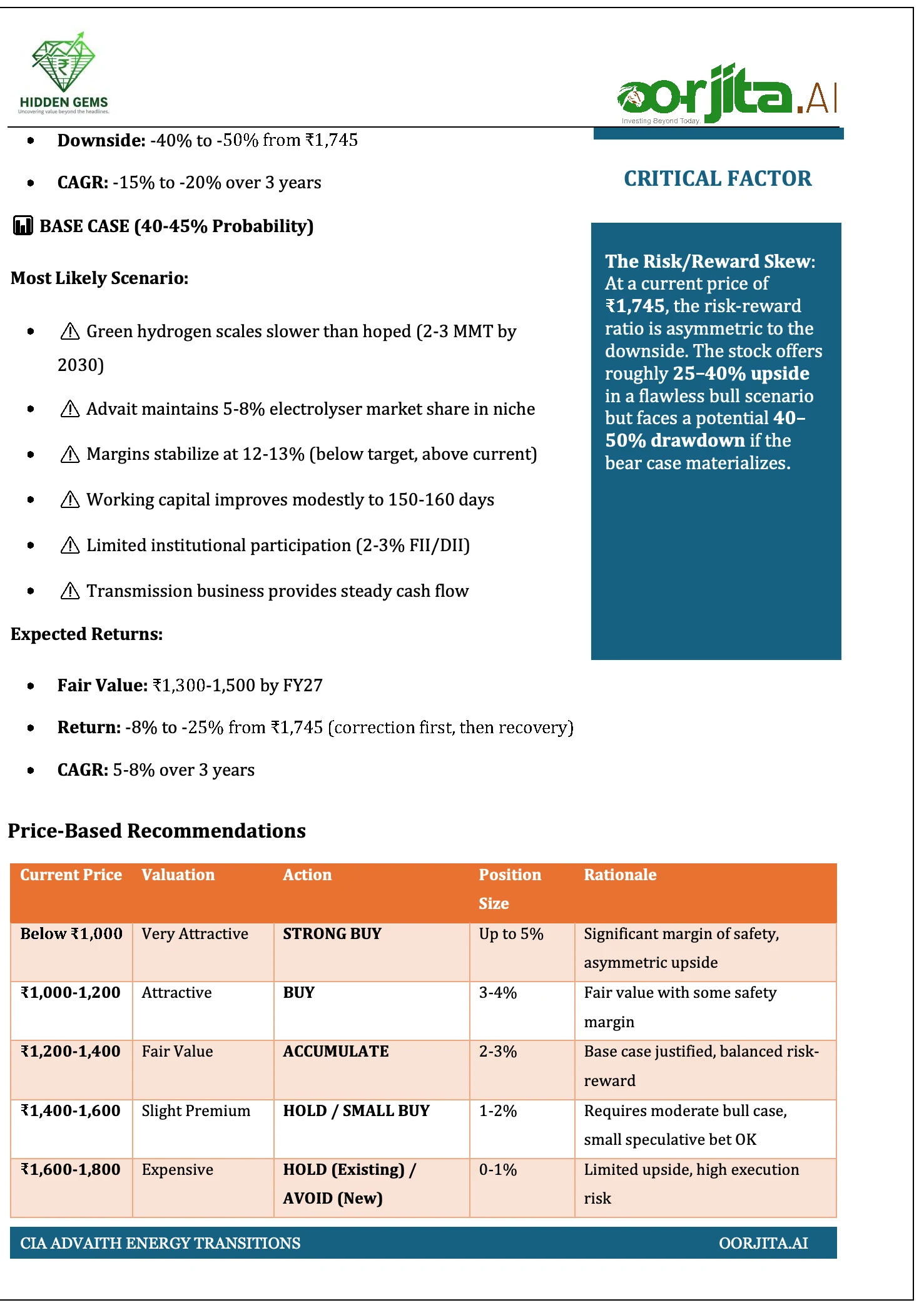
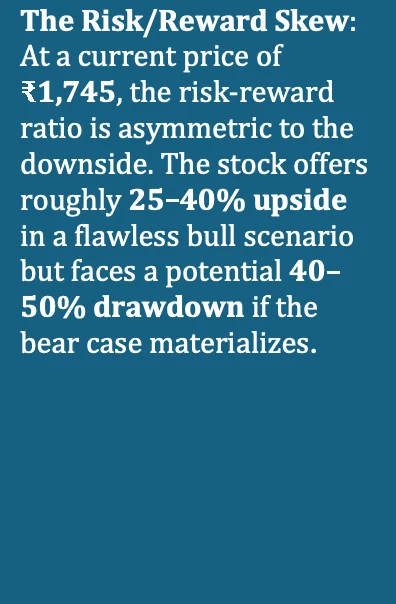
The risk-reward ratio is asymmetric to the downside at current prices. The stock offers limited upside (10-15% to fair value) but significant downside risk (40-50% in bear case).
Who Should Invest?
YES - Consider Investing IF:
You wait for correction to ₹1,200-1,400 levels
You have very high risk tolerance and 5+ year horizon
You allocate <3% of portfolio (speculative bucket)
You have strong conviction in India's green hydrogen opportunity
You can monitor quarterly and exit if triggers hit
NO - Avoid IF:
You need stable income or low volatility
You're a conservative investor
You require institutional validation before investing
You can't tolerate 40-50% drawdowns
Current price is your only entry opportunity (WAIT)
Three-Year Price Targets
Scenario
Probability
FY28 Price Target
3-Year CAGR from ₹1,745
Bear Case
30%
₹900-1,100
-15% to -20%
Base Case
45%
₹1,300-1,500
-5% to -8%
Bull Case
25%
₹2,200-2,500
+8% to +13%
Expected Value (Probability-Weighted)
100%
₹1,420
-6% CAGR
Conclusion
Advait Energy Transitions presents a compelling growth narrative in India's energy transition but suffers from execution challenges, governance weaknesses, and excessive valuation. At ₹1,745, the stock prices in an aggressive bull case with minimal margin for error.
For most investors: WAIT for:
Price correction to ₹1,200-1,400 (20-30% downside), OR
Margin recovery confirmation (2-3 consecutive quarters at 13%+ operating margin), OR
Institutional validation (FII/DII stake reaching 5%+) Only for high-risk thematic investors: Small position (1-2%) acceptable as speculative bet on green hydrogen theme, with strict stop-loss at ₹1,500 and quarterly monitoring of critical metrics. The company has potential to be a multi-bagger IF green hydrogen scales as planned and management executes flawlessly. However, current valuation leaves no room for disappointment, and multiple execution risks make this a "show me" story rather than a "buy and hold" opportunity at present prices. Best Strategy: Add to watchlist, monitor quarterly execution, and pounce on 25-30% correction or wait for fundamental inflection (margin recovery + institutional entry).
Next Review Due: Post Q4 FY26 Results (May 2026)
Disclaimer: This analysis is for educational and informational purposes only and does not constitute investment advice. Investors should conduct independent due diligence and consult qualified financial advisors before making investment decisions. Past performance does not guarantee future results. Small-cap stocks carry significantly higher risks than large-cap stocks, including liquidity risk, volatility, and business failure risk.
Disclosures and notes
Intellectual Property Portfolio
Patent Disclosure: Company has not publicly disclosed a significant patent portfolio in investor presentations or annual reports.
IP Strategy Assessment:
Weak proprietary IP: No evidence of breakthrough patents in core technologies
Partnership-based IP access: Leveraging partners' patents through licensing/JV
Trade secrets: Likely relying on manufacturing process know-how vs. patents
First-mover advantage: Speed to market rather than IP protection
Competitive Position:
Technology Followers rather than Technology Leaders
Access-based strategy: Acquiring technology through partnerships vs. internal R&D
Manufacturing excellence: Focus on production efficiency vs. invention
Compliance & Disclaimer
www.oorjita.ai is not operated by a broker, a dealer, or a registered investment adviser. Under no circumstances does any information posted on www.oorjita.ai represent a recommendation to buy or sell a security. The information on this site, and in its related newsletters, is not intended to be, nor does it constitute investment advice or recommendations. The information on this site is in no way guaranteed for completeness, accuracy or in any other way. In no event shall Oorjita Fin AI Services be liable to any member, guest or third party for any damages of any kind arising out of the use of any content or other material published or available on www.oorjita.ai, or relating to the use of, or inability to use, www.oorjita.ai or any content, including, without limitation, any investment losses, lost profits, lost opportunity, special, incidental, indirect, consequential or punitive damages. Past performance is a poor indicator of future performance.