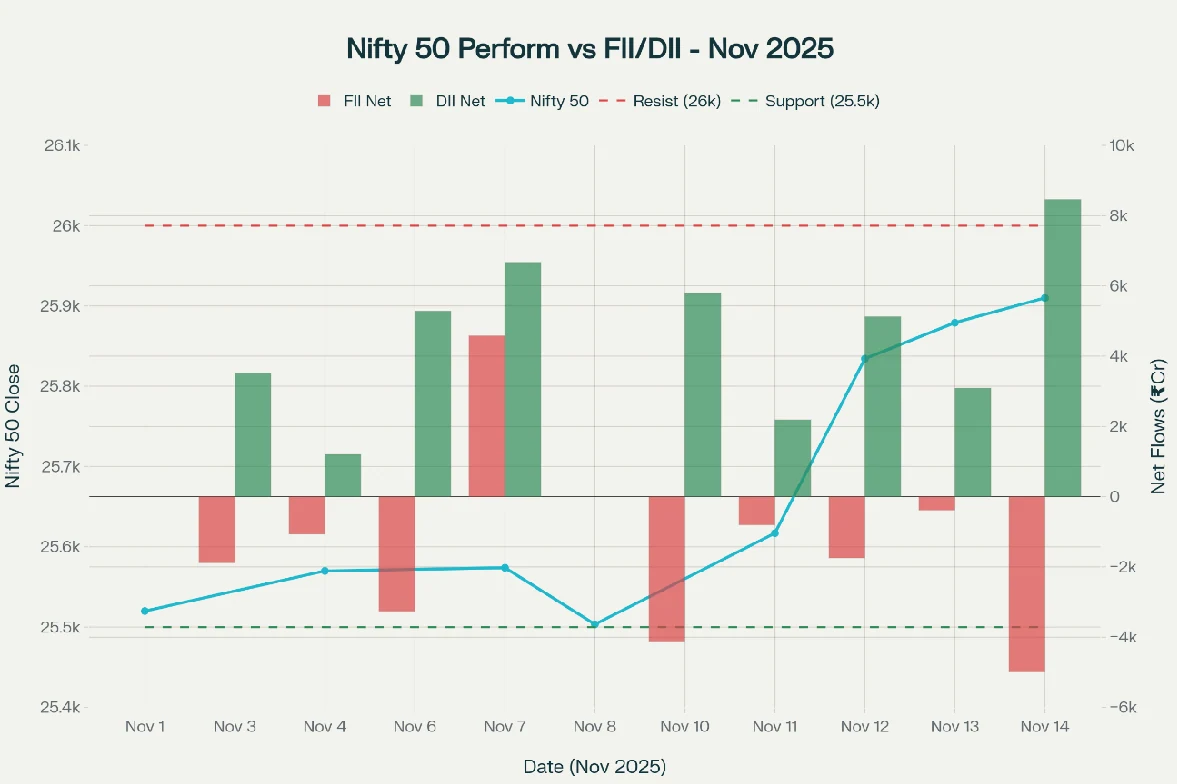
Indian markets are poised for a positive start this Monday after snapping a two-week losing streak with a +1.64% weekly gain. GIFT Nifty futures signal a firm opening, trading around 26,000-26,021 levels early morning, indicating strength after Friday's consolidation.

What's different today?: Domestic Institutional Investors (DIIs) continue to provide robust support, absorbing Foreign Institutional Investor (FII) selling pressure with net buying of ₹8,461 crore on November 14, while FIIs sold ₹4,968 crore.
Notable deal: Dunzo co-founder Kabeer Biswas: is in discussions to raise approximately $12 million for his new venture—a personal AI concierge startup—after recently departing Flipkart.
US Markets closed mixed Friday: The Dow Jones fell 309 points (-0.65%) to 47,147, while the S&P 500 dipped 0.05% to 6,734, and the Nasdaq edged up 0.1% after volatile trading.
Peer Comparison: While Taiwan (TSMC), South Korea (Samsung), and China dominate advanced node production (7nm and below), India is carving a niche in
Indian markets are poised for a positive start this Monday after snapping a two-week losing streak with a +1.64% weekly gain. GIFT Nifty futures signal a firm opening, trading around 26,000-26,021 levels early morning, indicating strength after Friday's consolidation.
India is positioning itself as a global semiconductor powerhouse with commitments exceeding $20 billion across multiple fabrication projects as of late 2025. The government's India Semiconductor Mission, backed by $10-18 billion in incentives, has approved 10 semiconductor projects totaling ₹1.6 trillion ($18.2 billion) as of this month.
Key developments: Union Minister Ashwini Vaishnaw confirmed that India's first domestically produced semiconductor chip will launch by end-2025, using 28-90 nanometer technology. The next phase of the mission will be launched within six months, focusing on new semiconductor hubs including Greater Noida.
Major investments: Larsen & Toubro announced plans to invest over $300 million to establish a fabless chip company, targeting 15 product designs by 2027. Tata-PSMC fab in Gujarat and the HCL-Foxconn joint venture represent significant private sector participation.
Indian startups raised over $135 million between November 10-15, 2025, across 25 companies spanning Legaltech, Edtech, Aerospace, Medtech, EV, and Deeptech sectors. This follows a robust previous week where startups raised $232 million, led by MoEngage's $100 million round.
Electronics Development Fund milestone: India's EDF has deployed approximately $30 million (₹258 crore) across eight venture capital funds since 2016, supporting 128 technology startups in robotics, AI, drones, cybersecurity, and autonomous systems. These investments have catalyzed ₹1,335.77 crore in total startup funding.
Notable deal: Dunzo co-founder Kabeer Biswas is in discussions to raise approximately $12 million for his new venture—a personal AI concierge startup—after recently departing Flipkart.
Friday's (Nov 14) Top Gainers: Tata Motors Commercial Vehicles surged +3.20% to ₹331, followed by Eternal (+2.15%), BEL (+1.60%), Axis Bank (+1.57%), and Trent (+1.52%) [NSE data]. The advance-decline ratio stood at 31:20, reflecting positive breadth [NSE data].
Top Decliners: Infosys led losses with -2.33%, followed by Eicher Motors (-2.27%), Tata Steel (-1.50%), and ICICI Bank (-0.92%) [NSE data].
Sectoral snapshot: Bank Nifty gained 0.12% to close at 58,517.55, with PSU banks and Axis Bank providing support, while Indusind Bank (-1.75%) and ICICI Bank weighed. Financial services, FMCG, and healthcare sectors are attracting selective DII buying.
US Markets closed mixed Friday: The Dow Jones fell 309 points (-0.65%) to 47,147, while the S&P 500 dipped 0.05% to 6,734, and the Nasdaq edged up 0.1% after volatile trading. Tech stocks faced pressure amid questions about AI rally sustainability.
Currency & Commodities: The Indian Rupee traded at approximately ₹88.76 per USD on November 17, maintaining relative stability in the 88.44-88.81 range over the past week. Crude oil hovered around $63-65 per barrel (WTI), down nearly 4% from recent highs on OPEC+ oversupply concerns. Gold prices in India stand at ₹12,508/gram for 24K, while global gold rose 0.43% to $4,101/troy ounce.
Asian markets cautious: Hang Seng futures fell 0.3%, Nikkei 225 futures rose 0.2%, reflecting mixed sentiment as investors await regional economic data.
The Opportunity: India's semiconductor sector is undergoing a transformational shift from a "design and assembly" hub to full-spectrum chip production. The government's ₹76,000 crore ($9-10 billion) India Semiconductor Mission, launched in 2021-22, has catalyzed nearly $20 billion in committed investments by late 2025.
Policy Evolution: The government pivoted strategy in 2022, expanding incentives from 28nm-and-smaller chips to cover 50% of project costs for all fabrication units, regardless of chip size, as well as testing and packaging facilities. This pragmatic shift recognizes India's emerging semiconductor ecosystem needs support across the maturity spectrum.
Global Context: Unlike China's proprietary standards approach, India is working with US and European standards, positioning itself as a "trusted partner" for Western buyers. The US signed a semiconductor MOU with India, and investments are protected by rule of law—critical differentiators in the current geopolitical climate.[13]
Peer Comparison: While Taiwan (TSMC), South Korea (Samsung), and China dominate advanced node production (7nm and below), India is carving a niche in 28-90nm mature nodes—critical for automotive, IoT, defense, and industrial applications that constitute ~70% of global chip demand by volume.
Investment Landscape: Six chip fabrication units are currently under development as of May 2025, with the government approving additional projects in Odisha, Punjab, and Andhra Pradesh. The Electronics Development Fund has seeded eight VC funds that have deployed ₹1,335 crore across 128 startups in enabling technologies—robotics, AI, drones, cybersecurity.
Risks & Contingencies: The semiconductor industry requires long-horizon capital (5-10 year payback), skilled manpower (India faces talent gaps in fabrication engineering), and stable power/water infrastructure. China's overcapacity in mature nodes also poses pricing pressure risks.
Actionable Investor Takeaway: Monitor fabrication equipment suppliers (Applied Materials, ASML supply chain partners), domestic electronics manufacturers (Dixon Technologies, Amber Enterprises, Kaynes Technology) that will integrate domestically-produced chips, and power infrastructure plays (transformer, switchgear companies) supporting fab construction. The government's target of a $100-110 billion domestic market by 2030 implies 14-16% CAGR—above global semiconductor growth rates.
"India is not trying to create proprietary standards to protect a domestic industry but is working with US and European standards. Western investments are protected by rule of law." — CEPA (Center for European Policy Analysis) report on India's semiconductor strategy, November 12, 2025
Disclaimer: This morning brief is prepared by Oorjita FinAI Services for informational and educational purposes only. It does not constitute investment advice, recommendation, or solicitation to buy or sell any securities.
Data Accuracy: All data has been validated using the Two-Source Rule with timestamps. However, market data is subject to revisions and corrections. {Provisional} and {Official} tags applied where applicable.
Forward-Looking Statements: This brief contains predictive analysis and scenario modeling based on current data. Actual market outcomes may differ materially due to unforeseen events, regulatory changes, or market dynamics.
No Liability: Oorjita FinAI Services and its research team assume no liability for investment losses arising from use of this information. All investment decisions are the sole responsibility of individual investors.
Regulatory Note: This brief is not registered with SEBI and does not constitute SEBI-registered research. It represents aggregated market intelligence for educational purposes.
This research is for information and education only and is not investment advice. Figures may be provisional. Oorjita.AI and its authors may hold positions in securities mentioned. Please consult a SEBI-registered investment adviser before making investment decisions. Published Monday, 17 November 2025, 8:14 AM IST.

Morning's Bear call was directionally validated, but the intraday recovery depth was underestimated. The market found its panic floor exactly where the morning brief mapped it — and then bounced.

*Note: 19-Feb (Chhatrapati Shivaji Maharaj Jayanti) — FBIL did not publish a fresh forex rate (carried 18-Feb forward); NSE equity market was operational; FII/DII data present.

1 advancing sector vs. 8 declining sectors Market Breadth: Negative (11% advance rate) Interpretation: Risk-off week; only financials held ground